A labor of love leads to mapping historic sites in a Chuuk island
BY JULIAN RYALL
Japan Correspondent
TONOAS, Chuuk — A Guam-based academic has led the publication of a map showing the key historic sites on the island of Tonoas, in the Federated States of Micronesia’s Chuuk state, and a complementary interactive web site — an initiative that is highlighting sites that are often overlooked in a destination best known for its underwater attractions.
William Jeffery, 74, has been a full-time associate professor of anthropology at the College of Liberal Arts & Social Studies at the University of Guam since 2015, but was previously based in Chuuk as maritime archaeologist for the FSM’s National Historic Preservation Office. He collaborated on the project — which can be found online — with Hiroshi Ishii, a researcher at the Center for Southeast Asian Studies at Kyoto University.
Originally fascinated by the dozens of Japanese warships and merchant vessels that were sunk by U.S. aircraft in Operation Hailstone in February 1944, Jeffery quickly realized that much work remains to be done to also document the presence of the Japanese on land between October 1914, when Tokyo took control of the islands from Germany, and its defeat in 1945.
“It has been stated that Tonoas had over 1,200 buildings related to the Japanese military and civilian occupation,” Jeffery told the Journal. “It was the headquarters for the Japanese military and civilian governments and the only island to have a Japanese township established, named Dublon Town.
“In 2002 to 2003, I really enjoyed working with older Chuukese people who were boys during the war and hearing their stories, and while none were alive when we did this project in 2023 to 2024, it was good to get back and do more.”
Even though it was not the largest island in Chuuk’s vast lagoon, the Japanese decided to make it their primary base, building far more military facilities than on the other islands. Fortunately, for historians, after Japan’s capitulation, the U.S. forces that replaced the Japanese moved the key functions of the state to Weno island, meaning that many Japanese structures survived.
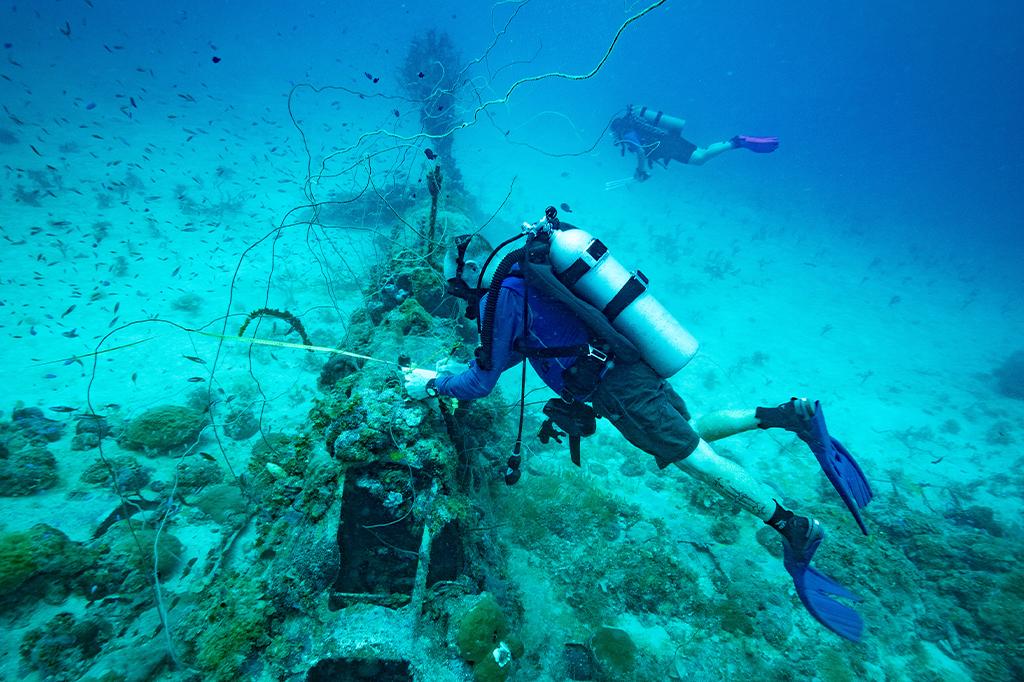
William Jeffrey (center) and Hiroshi Ishii above a Japanese warplane in the lagoon off Tonoas. Photos by Greg Adams
There has also been an active effort by Tonoas Mayor Gradvin Aiskek to promote tourism on the island and to encourage local people to preserve the sites.
Earlier in his research, Jeffery, who is originally from Adelaide in South Australia, spoke with as many residents who remembered the Japanese occupation as he could find, documenting their experiences. Memories of those years varied, he admitted.
“When I talked to the older men in 2002, who were boys during the war, they remember and also passed on stories to their kids about the harshness and even the brutality of the Japanese army in establishing the military facilities on the island, using local people as slaves,” he said.
“Some of these older men can remember the wonderful facilities on Tonoas in Dublon Town — the ice cream parlors, banks, movie theatre and hairdressers — and they missed them.”
They also recalled the island having electricity under the Japanese, something that was lost after the Japanese left and was not restored until as late as 2024.
“Some local people are happy to have tourists visit the sites, some seem reluctant — but nearly everyone knows about or experienced harsh times during the war, and many would just like to forget.”
Today, the only way to reach Tonoas is by boat, with the crossing from Weno taking about 20 minutes.
The island is the only one in Chuuk to have three names; it was known as Dublon, after a ship’s captain during the Spanish colonial period, then Natsushima, or “Spring Island,” under the Japanese, and now the Chuukese name.
The island covers around nine square kilometers and the main sites of interest can be reached on foot. Dublon Town was clustered around a small inlet on the south side of the island and was a bustling community of around 800 Japanese inhabitants during the pre-war years, with even an outdoor movie theater, newspaper office and cafes.
The area was targeted during the U.S. attacks and most of the buildings were destroyed, and little remains today. Further along the coast to the west is the seaplane base, which was again heavily bombed, with the shell of the power plant building and a large underground bunker designed to store aircraft slightly inland.
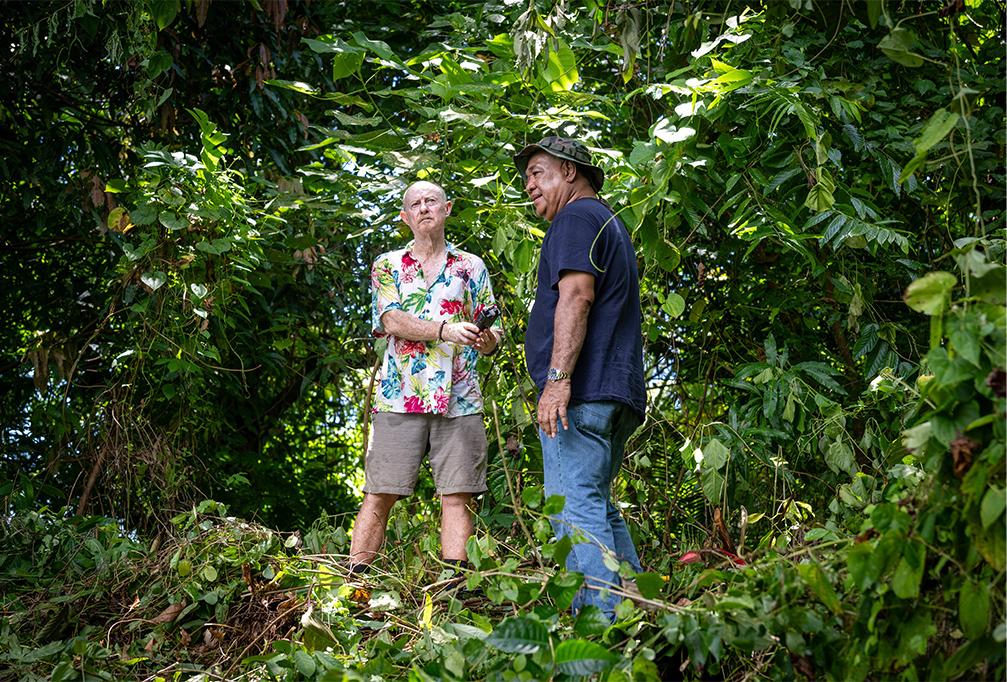
(From left) William Jeffrey with Tonoas Mayor Gradvin Aiskek.
Surrounded by thick jungle in the hills above Dublon Town is a hospital built in 1928 and the only one in Chuuk open to local people. After war had broken out, the Japanese occupying forces used it to treat wounded or ill service personnel.
The main buildings are concrete and have survived remarkably well. Wards are laid out neatly and there is a spacious central garden. Knee-high pillars and steps along one side indicate where wooden wards once stood. The floor of one room — possibly used for operations — remains tiled and the original garden still contains native Japanese plants.
A few hundred meters away is a school built by the Japanese for Chuukese children, although it later served as the local headquarters for the Japanese Territorial Government for the South Seas. Nearby is a stone memorial to businessman and adventurer Koben Mori — still a common family name among Chuukese — who arrived in the islands in 1891 and built a trading empire.
The island’s elementary school stands on the site of the Japanese military communications center, with stone pillars still at the entrance and the concrete bases of radio antennas dotted through the undergrowth. A long air raid bunker is also within the grounds of the school, with the Japanese moving their communications equipment to a larger bunker after the 1944 air raids.
The site is historically significant as it was from here in April 1943 that a message was sent providing the details of Adm. Isoroku Yamamoto’s inspection tour of military facilities throughout the South Pacific. Unbeknown to the Japanese, the U.S. had cracked the Japanese code, and on April 18, 16 P-38 lightning fighters intercepted Yamamoto’s aircraft and its escort of six Zero fighters over the Solomon Islands. Yamamoto, widely regarded as one of imperial Japan’s most capable military leaders, was killed.
Other interesting locations that can be visited include the steps and foundations of a Shinto Shrine, a 12.7cm anti-aircraft battery on the top of Nenengua hill and the site of the Japanese 4th Fleet Naval Headquarters.
Jeffery has completed the heritage trail map and web site but recommends that visitors still work with a local guide and offer a small cash payment for anyone wanting to access sites that are on private land. And he says much more work remains to be done to uncover more of the island’s past.
“There are many more sites and a lot more history to discover, especially Chuukese traditional sites and stories and how they were impacted by the war,” he said.
“I do not think many people know these stories now and some just want to forget about this painful period in their history, although Mayor Gradvin is making a big effort to encourage people,” he said. “It is partly business, but he does want to use tourism to help the people of Tonoas because tourism can bring greater access to electricity, better roads and so on.” mbj