












KOROR, Palau — More than three decades after it was built, Palau’s only hospital is firmly on a path toward replacement. President Surangel S. Whipps Jr. convened the first meeting of the Belau National Hospital Relocation Steering Committee on May 14, marking the start of what officials are calling the implementation phase of a project that many say is long overdue.
On May 13, Whipps signed Executive Order No. 503, which created the committee, which draws members from medicine, public health, engineering, tourism, and the President's office.
Task force members include Dr. Victor Yano and Dr. Emais Roberts, who also serves as governor of Peleliu State; both are senior physicians with admitting privileges at Belau National Hospital and operate private clinics. (See story: https://www.mbjguam.com/weighing-palau%E2%80%99s-medical-services)
The Relocation Steering Committee replaces a previous group that had been in place since 2021, which the new order formally dissolved. The shift signals a transition from broad feasibility planning to the work of site selection, design, and construction.
The project gained its most significant early backing in October 2024, when the United States Trade and Development Agency awarded a $2.37 million grant to Palau’s Ministry of Public Infrastructure and Industries to fund a comprehensive feasibility study. The grant agreement was signed on October 23, 2024, at a ceremony at the President’s Office in Koror, formalized by Minister of Public Infrastructure and Industry Charles Obichang and U.S. Ambassador to Palau Joel Ehrendreich, with President Whipps in attendance.
The grant was designed to fund more than just site analysis. Under the terms of the study, the feasibility work would also support roughly 30% of the engineering and architectural design for the new facility — a hospital planned to accommodate between 120 and 150 beds with substantially expanded medical capabilities.
The U.S. commitment deepened further in December 2025, when Washington and Koror signed a memorandum of understanding pledging continued American support for the hospital’s relocation and construction, building on the foundation laid by the USTDA grant.
Beyond the U.S. framework, Peace Winds Palau, Peace Winds America, and Taiwan's Shin Kong Hospital have been working alongside Palauan authorities to bolster near-term healthcare capacity, bringing in professionals and providing training while the relocation project takes shape.
“These organizations have been helping Palauans strengthen our health infrastructure by bringing in health care professionals, providing training, and assisting with other health care services,” the President said at the May 14 steering committee meeting. “I think it’s important that we have partners who bring different perspectives and help us on this journey.”
The Belau National Hospital — known locally as BNH — was constructed in 1993 with funding from the U.S. Department of the Interior. For more than thirty years, it has served as the sole hospital for the Republic of Palau, a Pacific Island nation of roughly 18,000 people spread across an archipelago of 340 islands, with the bulk of the population concentrated on Koror.
The facility’s age alone would be cause for concern. But BNH’s problems run deeper than wear and tear. The hospital sits in Meyuns, a low-lying coastal area of Koror that is vulnerable to storm tides. On at least two separate occasions, patients have had to be evacuated to higher ground when severe weather threatened the building. Emergency services at the facility are chronically overloaded, and a persistent shortage of physicians has forced Palauans to seek specialized care abroad — a costly arrangement that drains the national budget of millions of dollars annually. The island nation’s harsh coastal environment accelerates the physical deterioration of the building itself.
The push to relocate BNH is not new. As far back as July 2019, the Senate of Palau’s 10th Olbiil Era Kelulau — the national legislature — proposed legislation to move the hospital to a more secure location, citing the growing risks posed by climate change.
In the last two years, state governments of Koror, Airai and Ngatpang have passed resolutions offering public lands as potential sites for the new facility. The competition to host the hospital underscored both the project’s economic significance and the broad public recognition that the status quo was unsustainable.
In February, President Whipps signed a contract with Honolulu-based Architects Hawaii Ltd., selecting the firm as implementing partner for the feasibility study. (See story: https://www.mbjguam.com/bird-hand-palau-walks-away-hospital-deal). The agreement tasked the firm with conducting the USTDA-funded study, including the critical work of evaluating candidate sites and developing the architectural foundation for the new facility.
“Today’s milestone is exactly the kind of tangible progress that strengthens partnerships and delivers meaningful results for the United States and Palau,” said Thomas R. Hardy, USTDA’s Deputy Director, at the time of the contract award.
By early April 2026, a delegation from the firm were on the ground in Palau, touring candidate sites alongside Whipps, Obichang and infrastructure officials.
When completed, the new Belau National Hospital is envisioned as a facility of up to 120 beds. The planned facility would bring advanced medical capabilities to Palau that are presently unavailable in-country, including emergency care infrastructure, specialized surgical suites, and modern diagnostic technologies.
Among the specific goals articulated by officials is dedicated healthcare for U.S. military veterans — a population Whipps has repeatedly highlighted as deserving expanded services.
“As we also look to expand services for veterans, the new hospital can also be outfitted to provide healthcare services specifically for the needs of those who have sacrificed to defend freedom,” the President has said.
Palau moves into implementation phase on long-awaited hospital relocation
Palau moves into implementation phase on long-awaited hospital relocation
- Date Posted: May 24, 2026
- News: Guam, Palau
-
Share this News
Palau moves into implementation phase on long-awaited hospital relocation
Recommended Articles...
Guam Business Magazine comments on Sen. William Parkinson’s amendment and release
Guam Business Magazine appreciates the fact that Sen. William A. Parkinson reads the magazine, as do other senators, and no doubt he reads the Marianas Business Journal also.
Read More 
Guam utility systems near full restoration; bucket trucks return from Saipan
One week after Super Typhoon Bavi, Guam’s public utility infrastructure has approached near-total recovery, with the island-wide power system restoring 96% of customer demand and the water utility bringing 95 wells back online.
Read More 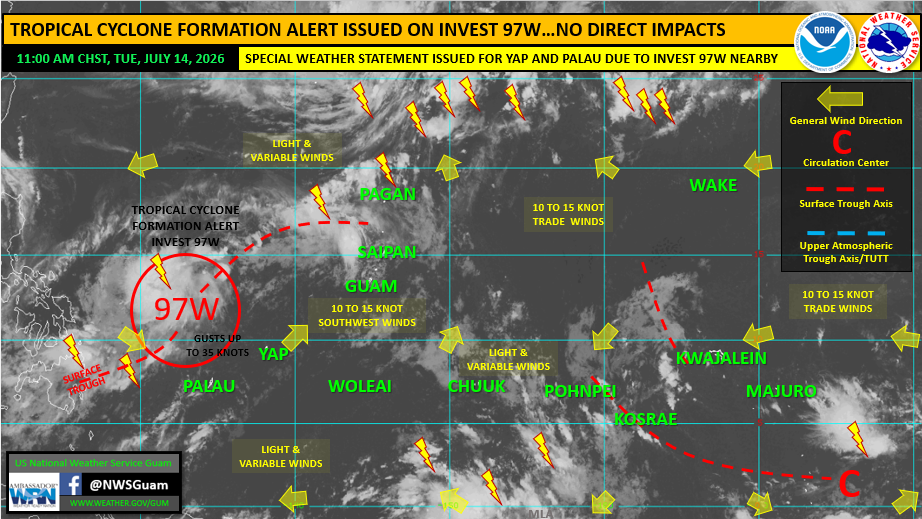
Regional monsoon to strengthen as tropical disturbance lingers near Yap
A regional tropical cyclone formation alert has been issued as a developing weather disturbance northwest of Yap threatens to strengthen the seasonal monsoon across western Micronesia and the Mariana Islands.
Read More 
Guam National Guard and Washington National Guard joins military exercise Alupang ACE in Palau, supports Valiant Shield 2026
Contributing to Valiant Shield 2026, the Guam National Guard joined the Washington National Guard in Palau to demonstrate expeditionary sustainment exercises providing logistics, medical, and communication support.
Read More