












BY DANIEL M. PEREZ
Journal Staff
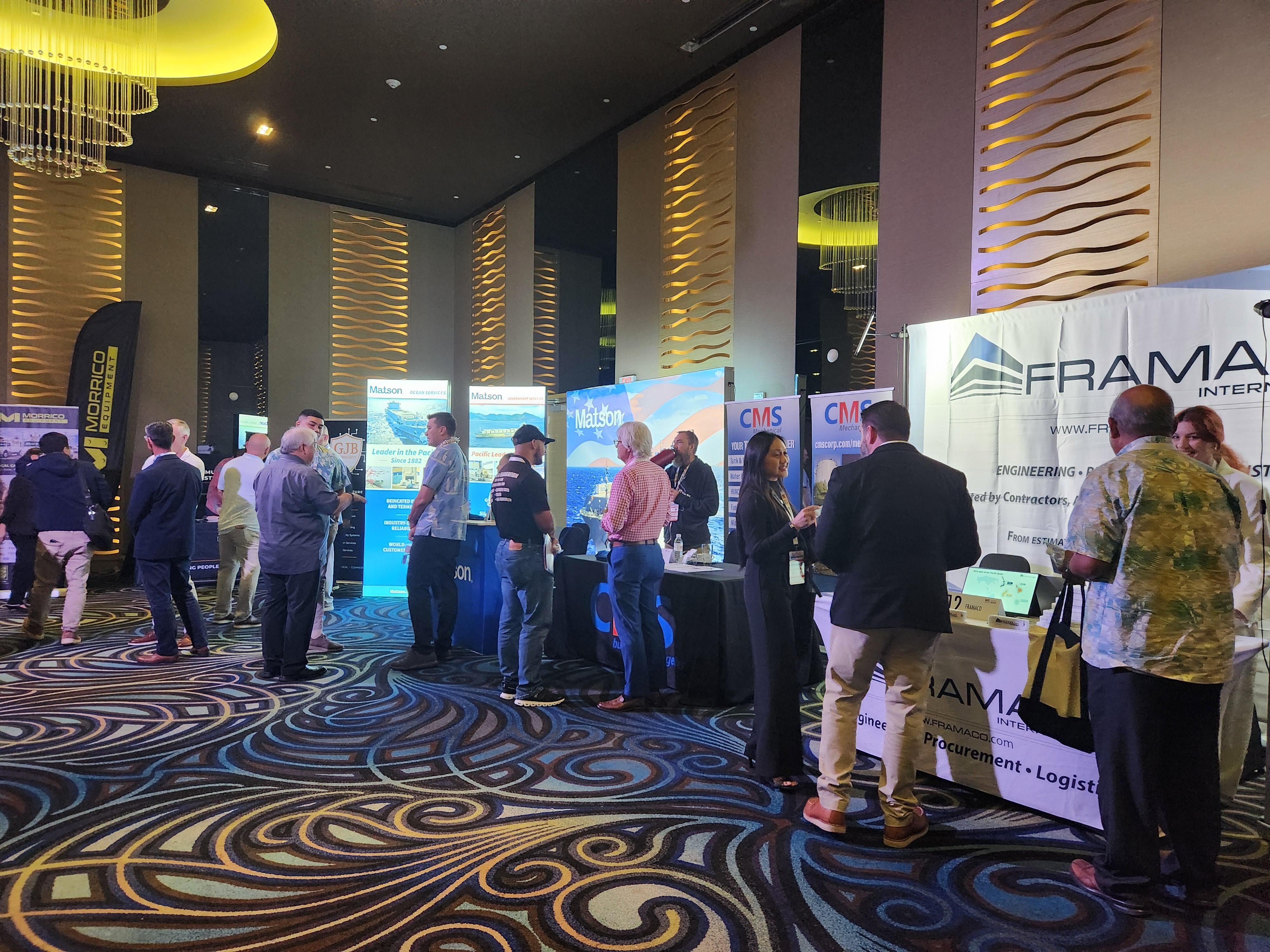
TUMON, Guam — More than 500 construction contractors, engineers, architects, and other industry professionals from Guam, the Northern Mariana Islands, the Indo-Pacific region, and the U.S. mainland gathered at the Dusit Thani Guam Resort for the Society of American Military Engineers Guam Post 2026 Industry Forum from July 28 to 30.
The three-day conference focused on regional readiness, military infrastructure expansion, and supply chain logistics across the second and third island chains. During the "Regional Readiness" panel discussion, military leaders and industry executives addressed the complex operational requirements of constructing and sustaining military assets outside Guam.
Doyon Morato, director of strategic development at Marunda Defense Services Ltd. and first vice president of the S.A.M.E. Guam Post, served as moderator for the panel. Morato highlighted the necessity of synchronized collaboration between military agencies, local communities, and private contractors to deliver critical infrastructure across remote Pacific locations.
Col. Ben Knost of the 356th Expeditionary Theater Support Group, emphasized that engineering and logistics capabilities serve as a primary strategic deterrent against conflict in the region. "Engineering is one of the seven core functions of logistics, and logistics is deterrence, period," Knost said. "If we can highlight that we can sustain our force for as long as we need to continue to fight, that fight is much less likely." Knost explained that regional defense requires established central hubs on Guam as well as operational "spokes" throughout surrounding island chains, including projects at Tinian, Northwest Field, and Peleliu.
"Everywhere we are, we're at risk," Knost said. "We have to be able to move, we have to be able to do logistics in a contested environment, and we have to be able to recover those airfields and ports."
Aaron C. Isle, vice president of SLSCO Federal Services and president of the SAME Guam Post, stressed that defense builders face compounded logistical hurdles when operating outside Guam's commercial ecosystem. "The theme of this panel is that readiness doesn't stop at Guam's shoreline," Isle said. "Every challenge that we've spent the last decade trying to solve on Guam, the logistics, the labor, the housing, and the materials, gets harder the moment you leave Guam."
Isle said that mobilization and baseline utility establishment often account for 33% to 50% of total project costs on isolated islands before core construction can begin. "In most of these locations, the industrial base that we take for granted doesn't exist," Isle said. "You don't just bid the project; you build the ecosystem that builds the project."
Capt. Ryan Goldrick with the 254th Red Horse Squadron, outlined the active role military troop construction units play in restoring airfields, taxiways, and storage facilities across the Pacific. "We're aligning a lot of projects in the region, and our biggest challenge right now is materials on island and logistics," Goldrick said.
Goldrick added that military engineering units must rely on private defense contractors to support long-term maintenance and operations after initial construction is completed. "We're not able to construct everywhere all over the Pacific at one time," Goldrick said. "We'll rely heavily on long-term sustainment, which is going to require contract support."
The panel concluded with discussions on aligning environmental permitting, navigating land lease negotiations in the NMI, the Federated States of Micronesia, and Palau, and expanding port infrastructure to support intermodal freight transport throughout the Pacific theater. mbj
Journal Staff
TUMON, Guam — More than 500 construction contractors, engineers, architects, and other industry professionals from Guam, the Northern Mariana Islands, the Indo-Pacific region, and the U.S. mainland gathered at the Dusit Thani Guam Resort for the Society of American Military Engineers Guam Post 2026 Industry Forum from July 28 to 30.
The three-day conference focused on regional readiness, military infrastructure expansion, and supply chain logistics across the second and third island chains. During the "Regional Readiness" panel discussion, military leaders and industry executives addressed the complex operational requirements of constructing and sustaining military assets outside Guam.
Doyon Morato, director of strategic development at Marunda Defense Services Ltd. and first vice president of the S.A.M.E. Guam Post, served as moderator for the panel. Morato highlighted the necessity of synchronized collaboration between military agencies, local communities, and private contractors to deliver critical infrastructure across remote Pacific locations.
Col. Ben Knost of the 356th Expeditionary Theater Support Group, emphasized that engineering and logistics capabilities serve as a primary strategic deterrent against conflict in the region. "Engineering is one of the seven core functions of logistics, and logistics is deterrence, period," Knost said. "If we can highlight that we can sustain our force for as long as we need to continue to fight, that fight is much less likely." Knost explained that regional defense requires established central hubs on Guam as well as operational "spokes" throughout surrounding island chains, including projects at Tinian, Northwest Field, and Peleliu.
"Everywhere we are, we're at risk," Knost said. "We have to be able to move, we have to be able to do logistics in a contested environment, and we have to be able to recover those airfields and ports."
Aaron C. Isle, vice president of SLSCO Federal Services and president of the SAME Guam Post, stressed that defense builders face compounded logistical hurdles when operating outside Guam's commercial ecosystem. "The theme of this panel is that readiness doesn't stop at Guam's shoreline," Isle said. "Every challenge that we've spent the last decade trying to solve on Guam, the logistics, the labor, the housing, and the materials, gets harder the moment you leave Guam."
Isle said that mobilization and baseline utility establishment often account for 33% to 50% of total project costs on isolated islands before core construction can begin. "In most of these locations, the industrial base that we take for granted doesn't exist," Isle said. "You don't just bid the project; you build the ecosystem that builds the project."
Capt. Ryan Goldrick with the 254th Red Horse Squadron, outlined the active role military troop construction units play in restoring airfields, taxiways, and storage facilities across the Pacific. "We're aligning a lot of projects in the region, and our biggest challenge right now is materials on island and logistics," Goldrick said.
Goldrick added that military engineering units must rely on private defense contractors to support long-term maintenance and operations after initial construction is completed. "We're not able to construct everywhere all over the Pacific at one time," Goldrick said. "We'll rely heavily on long-term sustainment, which is going to require contract support."
The panel concluded with discussions on aligning environmental permitting, navigating land lease negotiations in the NMI, the Federated States of Micronesia, and Palau, and expanding port infrastructure to support intermodal freight transport throughout the Pacific theater. mbj