














BY DANIEL M. PEREZ
Journal Staff
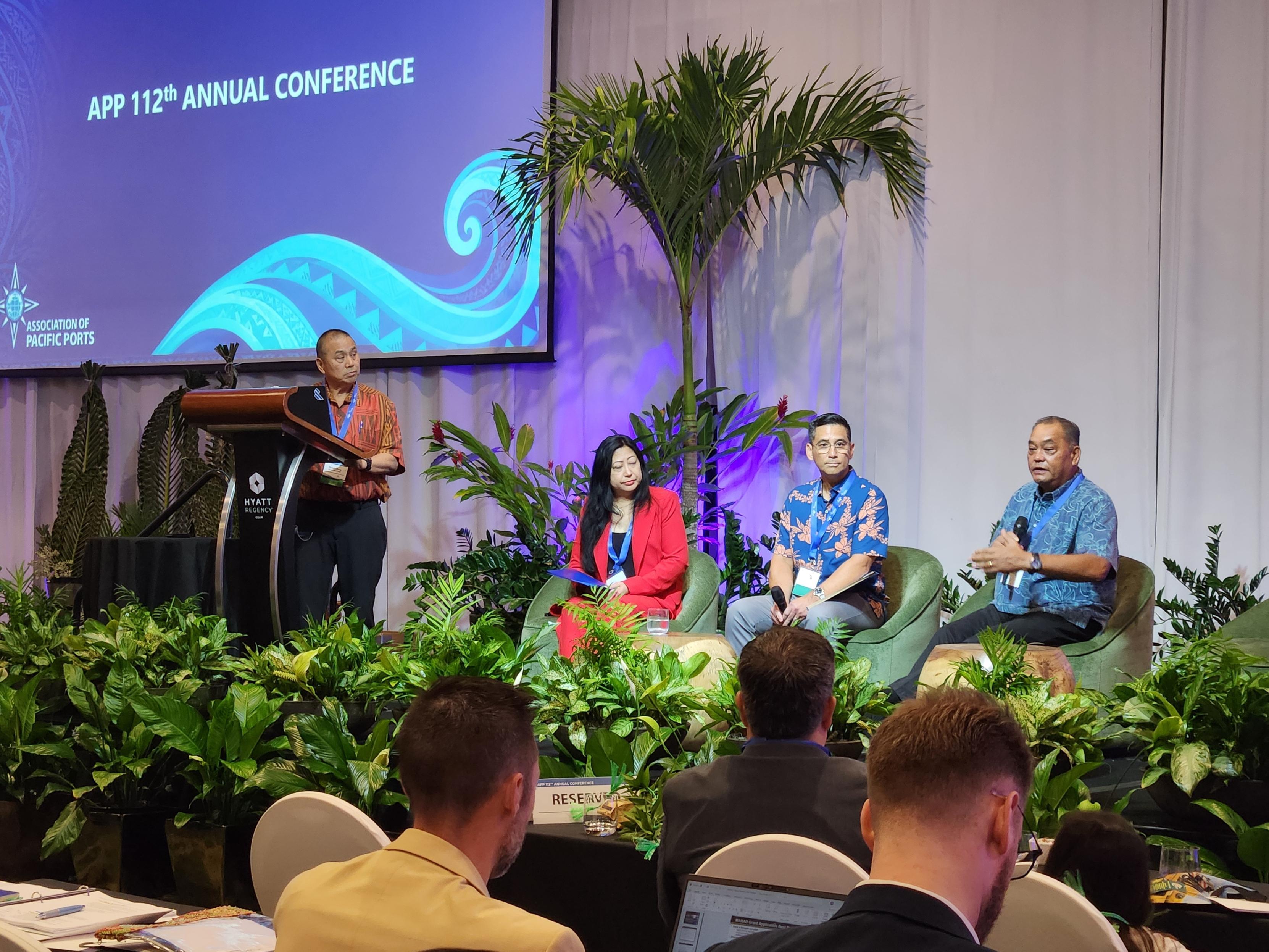
Commercial maritime carriers and terminal operators across the Western Pacific are adjusting operational strategies, upgrading equipment, and enhancing regional coordination to support accelerating military construction and troop relocations.
Speaking on the "From Trade Gateways to Strategic Logistics Platforms" panel during the second day of the Association of Pacific Ports 112th Annual Conference, industry leaders addressed how commercial ports must evolve into multi-faceted logistics platforms. The regional surge, driven by the Marine Corps relocation from Okinawa to Guam and active infrastructure projects on Tinian, Yap State, and Peleliu, demands the efficient movement of heavy equipment, fuel, construction materials, and humanitarian supplies.
Lee Cabrera, president of the Association of Terminal Operators, Stevedoring and Shipping Companies of Micronesia, highlighted the operational constraints facing smaller ports in the Northern Mariana Islands compared to Guam. Cabrera explained that while Guam operates high-capacity gantry cranes, outer-island facilities rely on lattice and hydraulic mobile cranes. "For our isolated islands, we really need to prepare to service all cargo needs," said Cabrera.
Cabrera explained that incoming defense shipments frequently include heavy pavers, articulated trucks, and aggregate for major infrastructure initiatives, such as the U.S. Air Force Red Horse unit repaving four World War II airfields on northern Tinian. Shallow island waters, reefs, and tidal fluctuations require precise discharge planning and roll-on, roll-off capabilities. "Open collaboration, communication, and dialogue with the agents, carriers, and contractors is very, very key," Cabrera said.
Michelle Quidachay, general manager of APL Guam and Saipan, detailed how ocean carriers are fortifying maritime supply chains against infrastructure vulnerabilities. APL operates the U.S.-flag Guam Saipan Express service, connecting West Coast ports in Los Angeles and Oakland through Yokohama, Japan, to Guam and Saipan. Transit times stand at 24 days from Los Angeles, 18 days from Oakland, and three and a half days from Yokohama to Guam.
Quidachay emphasized that feeder vessels APL Oceania and APL Islander carry self-sustaining shipboard cranes. "Even if port gantry cranes are down, APL is still able to discharge our containers," said Quidachay, citing past operational continuity following Typhoon Mawar. Parent company CMA CGM provides access to commercial trade networks spanning 160 countries. "This network opens up your buying power where you can source product from basically anywhere in the world," Quidachay explained.
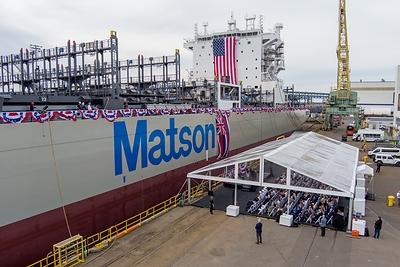
Patrick Bulaon, vice president and general manager for Guam and Micronesia at Matson Navigation Co., emphasized the geographical challenges and equipment demands of serving isolated Pacific island communities. "Guam to Hawaii is farther away than Hawaii is to the U.S. mainland," said Bulaon. To transport heavy military machinery and oversized construction freight throughout Guam, the NMI, and the Federated States of Micronesia, Matson utilizes combination container and roll-on, roll-off vessels equipped with enclosed stern garages. "We find innovative ways to allow that cargo to be loaded." Bulaon said, adding that direct vehicle discharge capabilities remain critical as regional infrastructure development accelerates. mbj
Journal Staff
Commercial maritime carriers and terminal operators across the Western Pacific are adjusting operational strategies, upgrading equipment, and enhancing regional coordination to support accelerating military construction and troop relocations.
Speaking on the "From Trade Gateways to Strategic Logistics Platforms" panel during the second day of the Association of Pacific Ports 112th Annual Conference, industry leaders addressed how commercial ports must evolve into multi-faceted logistics platforms. The regional surge, driven by the Marine Corps relocation from Okinawa to Guam and active infrastructure projects on Tinian, Yap State, and Peleliu, demands the efficient movement of heavy equipment, fuel, construction materials, and humanitarian supplies.
Lee Cabrera, president of the Association of Terminal Operators, Stevedoring and Shipping Companies of Micronesia, highlighted the operational constraints facing smaller ports in the Northern Mariana Islands compared to Guam. Cabrera explained that while Guam operates high-capacity gantry cranes, outer-island facilities rely on lattice and hydraulic mobile cranes. "For our isolated islands, we really need to prepare to service all cargo needs," said Cabrera.
Cabrera explained that incoming defense shipments frequently include heavy pavers, articulated trucks, and aggregate for major infrastructure initiatives, such as the U.S. Air Force Red Horse unit repaving four World War II airfields on northern Tinian. Shallow island waters, reefs, and tidal fluctuations require precise discharge planning and roll-on, roll-off capabilities. "Open collaboration, communication, and dialogue with the agents, carriers, and contractors is very, very key," Cabrera said.
Michelle Quidachay, general manager of APL Guam and Saipan, detailed how ocean carriers are fortifying maritime supply chains against infrastructure vulnerabilities. APL operates the U.S.-flag Guam Saipan Express service, connecting West Coast ports in Los Angeles and Oakland through Yokohama, Japan, to Guam and Saipan. Transit times stand at 24 days from Los Angeles, 18 days from Oakland, and three and a half days from Yokohama to Guam.
Quidachay emphasized that feeder vessels APL Oceania and APL Islander carry self-sustaining shipboard cranes. "Even if port gantry cranes are down, APL is still able to discharge our containers," said Quidachay, citing past operational continuity following Typhoon Mawar. Parent company CMA CGM provides access to commercial trade networks spanning 160 countries. "This network opens up your buying power where you can source product from basically anywhere in the world," Quidachay explained.
Patrick Bulaon, vice president and general manager for Guam and Micronesia at Matson Navigation Co., emphasized the geographical challenges and equipment demands of serving isolated Pacific island communities. "Guam to Hawaii is farther away than Hawaii is to the U.S. mainland," said Bulaon. To transport heavy military machinery and oversized construction freight throughout Guam, the NMI, and the Federated States of Micronesia, Matson utilizes combination container and roll-on, roll-off vessels equipped with enclosed stern garages. "We find innovative ways to allow that cargo to be loaded." Bulaon said, adding that direct vehicle discharge capabilities remain critical as regional infrastructure development accelerates. mbj