Prime Power International LLC has joined the ranks of small businesses entering the Guam market, but the electrical contractor may have an advantage from the get-go.
While the construction and contracting market offers opportunities for all sorts of expertise, the number of electrical contractors is limited.
The Guam Contractors Licensing Board lists more than 90 contractors, but less than 20 are in the electrical field.
“There is a significant shortage of qualified tradesmen and electrical contractors on Guam,” Sean Carbonneau, president of Prime Power, told the Journal. “That goes beyond electrical, it goes into telecommunications, fire alarms, security — all these things are very much needed.
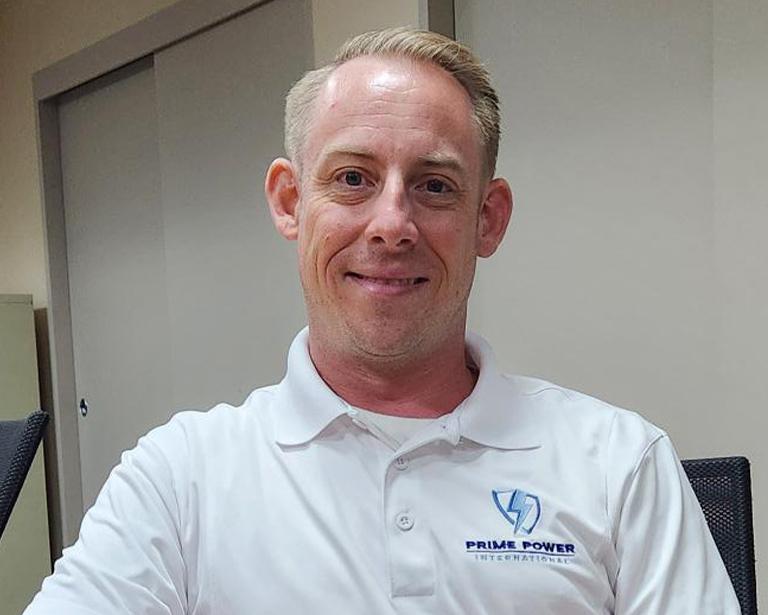
Sean Carbonneau is the president of Prime Power International LLC. Photo by Maureen N. Maratita
One important reason would be the amount of electrical contracting in the U.S. mainland.
“There is so much work in the U.S., especially with the data centers. All of the larger contractors and sub-contractors who would normally participate in the Guam market – they don’t have much interest or motivation to come out and work in an austere location like this because there’s simply so much lucrative work in the mainland.”
“Right now, we’re small,” Carbonneau told the Journal. “We’re a team of approximately six. I have a director of administration overseeing finance, HR, compliance, and providing critical project support, a supervisor and a number of electricians and apprentices.”
But expansion is just around the corner, he said. “Ideally in the next six months we’ll be looking to expand into bricks and mortar.”
Meanwhile, Carbonneau and his team have their hands full.
“We’ve been very fortunate; we’ve pulled in a few contracts right out of the gate, which is going to allow us some early cash flow.”
Those are sub-contracts, Carbonneau said. “We won’t be going after any prime contracts for the foreseeable future,” he said. Prime Power is targeting electric contracts from $10,000 to about $500,000, he said, with a focus on federal and commercial work. The company is busy with two of each on its books. “We pulled those in our first three to four weeks in business; we’re really happy.”
There is plenty of work available, he said. “A lot of the commercial market is struggling to find good, qualified contractors to support their needs. We’ve had a number of commercial customers.
Carbonneau has a specific focus on making apprenticeships available, he said. He is a master electrician after initially qualifying from the Manchester School of Technology in New Hampshire, before embarking on his career.
“Part of being in the trades — it’s our duty to pass on the skills and the knowledge that were taught to us. I truly believe it’s my duty and responsibility to the trades to continue to foster that for younger generations and to teach those skill sets to the trades.”
Guam offers Carbonneau and Prime Power the opportunity to do that, he said.
“I have a wonderful and rewarding relationship with the folks over at the Guam Trades Academy,” he said. “They are a wonderful group and the programs that they are running over there are absolutely phenomenal.”
The trades academy has a full four-year apprenticeship program. “If you are a member of the Guam Contractors Association, you are eligible to send your apprentices through their apprenticeship program through sponsorship and grants that the Trades Academy gets through the H-2B programs on the island,” Carbonneau said.
“Working with them, I think we have got about 20 electrical apprentices — and that’s going to be one of the main focuses of Prime Power. My company is adapting a company strategy and program where we’re a training company; we’re a teaching company,” Carbonneau said.
A large percentage of the company’s workforce will be apprentices, he said. “The way the program works … they work fulltime with me; they do their 40 hours and then two nights a week they go to night school for two or three hours a night. It actually allows them to work fulltime to get their in-the-field training and hands-on experience while also being paid and getting benefits … and then they do their night school two nights a week.” The policy for apprentices at Prime Power includes the requirement that apprentices attend the training, alongside sponsorship by the company.
Carbonneau said that in due course, Prime Power will extend its work throughout the region.
“We’re primarily focused on Guam, but eventually we do want to have a permanent presence in Saipan, with the ability to support the greater CNMI, Palau and the other islands,” he said.
While inventory and the supply chain are not a problem for his sector, Carbonneau said, “The industry never really recovered with regards to lead times for equipment. COVID really did a number as far as manufacturing lead times on a lot of the electrical equipment like panel boards, transformers and so on.” Only small improvements have been seen, he said. “That’s where the planning and the logistics really comes into play.”
What has helped, Carbonneau said is the ability to get equipment from South Korea.
“South Korean manufacturers are now doing U.S.-standard transformers and equipment and so on and due to South Korea’s relationship with the United States there are certain exceptions and programs that allow those products to be used under the Buy America Act on U.S. military projects. So we are seeing some relief coming from South Korea …,” he said.
Originally from New Hampshire, Carbonneau first came to Guam about a decade ago.
“I had previously been working in military contracting. When you get involved in the market, you hear about the other places around the world where the military operations are happening.” While he had heard about Guam, Carbonneau said he did not know too much about the island. “I did a little bit of research and became very interested in the island, the culture, the location. It seemed like a beautiful place to live and work.”
Arriving in Guam in 2016 to work fulltime after accepting a job opportunity, his work then took him to various locations outside of the island. “I came back here in 2023; that’s when I came out here permanently.”
Carbonneau said, “We came out here with a five-year plan; we’re two years into that. Now that we’ve started a company, that five-year plan goes out the window at this point. We’ll reassess it again.”
But there are plans, he said. “Our goal is to grow responsibly and to grow in a manner that also allows us to maintain our quality, our standards and the safety of our workers. A lot of the contractors out here have grown rather quickly and there are some tradeoffs.
“My goal with Prime Power is to raise the bar as far as the electrical trade and industry on Guam.”
Launching the company was a natural progression, Carbonneau said. “I started off as an apprentice in the field, got my journeyman license and I’ve slowly worked my way up through every position in the industry, most recently as director of operations for a large contractor. This progression into businessowner, president and operator really is the next step for me. It’s a position that I’m comfortable with and the response from the construction industry around the island has been phenomenal,” he said.
“I’ve received a lot of positive responses from companies eager to work with and partner with. So, I have the support of the community, which to me is most important because that gives me the peace of mind of knowing that the business will be supported and embraced as part of the overall market.” mbj
Guam Business Magazine appreciates the fact that Sen. William A. Parkinson reads the magazine, as do other senators, and no doubt he reads the Marianas Business Journal also.
One week after Super Typhoon Bavi, Guam’s public utility infrastructure has approached near-total recovery, with the island-wide power system restoring 96% of customer demand and the water utility bringing 95 wells back online.
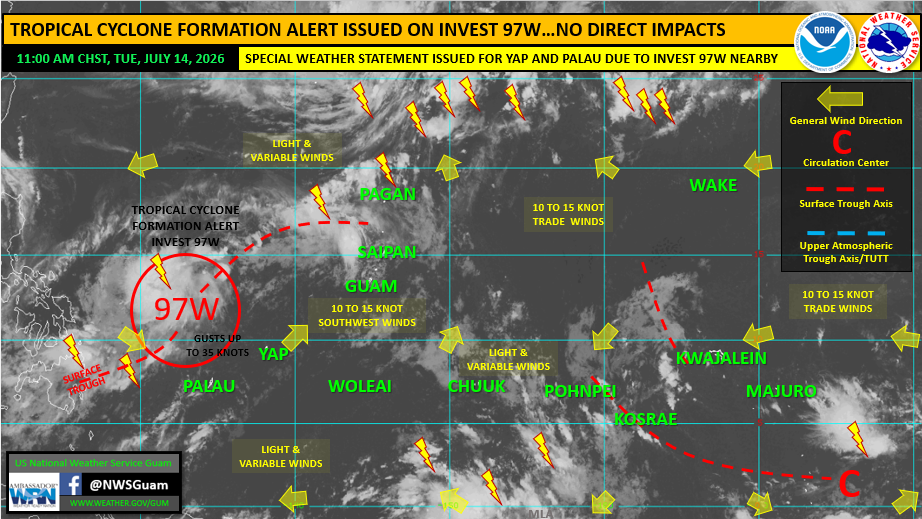
A regional tropical cyclone formation alert has been issued as a developing weather disturbance northwest of Yap threatens to strengthen the seasonal monsoon across western Micronesia and the Mariana Islands.
Contributing to Valiant Shield 2026, the Guam National Guard joined the Washington National Guard in Palau to demonstrate expeditionary sustainment exercises providing logistics, medical, and communication support.