It has been at least more than two decades since the peak of Guam’s tuna transshipment and fishing industry; an industry that at one point, grossed nearly $3.5 million in tax revenues, created 150 direct jobs, and $33 million in 1990 expenditures according to a 1991 report by the Guam Department of Commerce.
Adjusting for inflation, those expenditures would be valued at roughly $82.1 million and $8.7 million in tax revenues in 2026.
Guam’s tuna industry began in the mid-1980s, when longline tuna boats off-loaded lower-grade sashimi tuna at the Port of Guam. The catch was then loaded onto wide-body planes bound for Japan.
It is worth noting that 10% of the tuna landed at the port were not suitable for transshipment to Japan. Those “reject” fish were either frozen and stored for shipment to Asian canneries or entered the island’s seafood market as low-grade fresh fish.
By 1990, 300 plus longliners and purse seine tuna vessels made Apra Harbor their home port and a year later, operations expanded for air transshipment of tuna from locations across Micronesia.
Today, tuna-based commercial fishing on Guam is essentially extinct. The bulk of fishing centers around a number of species of reef fish according to data compiled by the University of Guam Marine Laboratory and the Guam Division of Aquatic and Wildlife Resources. Most of the fishers today are either subsistence or part-time commercial fishermen, operating boats smaller than 25 feet in length.
A part of the reason for the decline, according to the Pacific Islands Oceanic Fisheries Management Project, is the rise in high seas transshipments. These transshipments bypass ports like Guam to avoid costs and regulation.
The Port Authority of Guam wrote in its 1990 master plan that high labor costs, limits on the number of vessels allowed to land fish outside of Japan, and the allure of other transshipment hubs in the region contributed to the industry’s decline and according to Journal files, one company, Zee Enterprises, operated by tuna icon Lawrence Zuanich, paid anywhere from $250,000 to $500,000 on crew salaries, taxes, and supplies each time one of its seven boats made port on Guam.
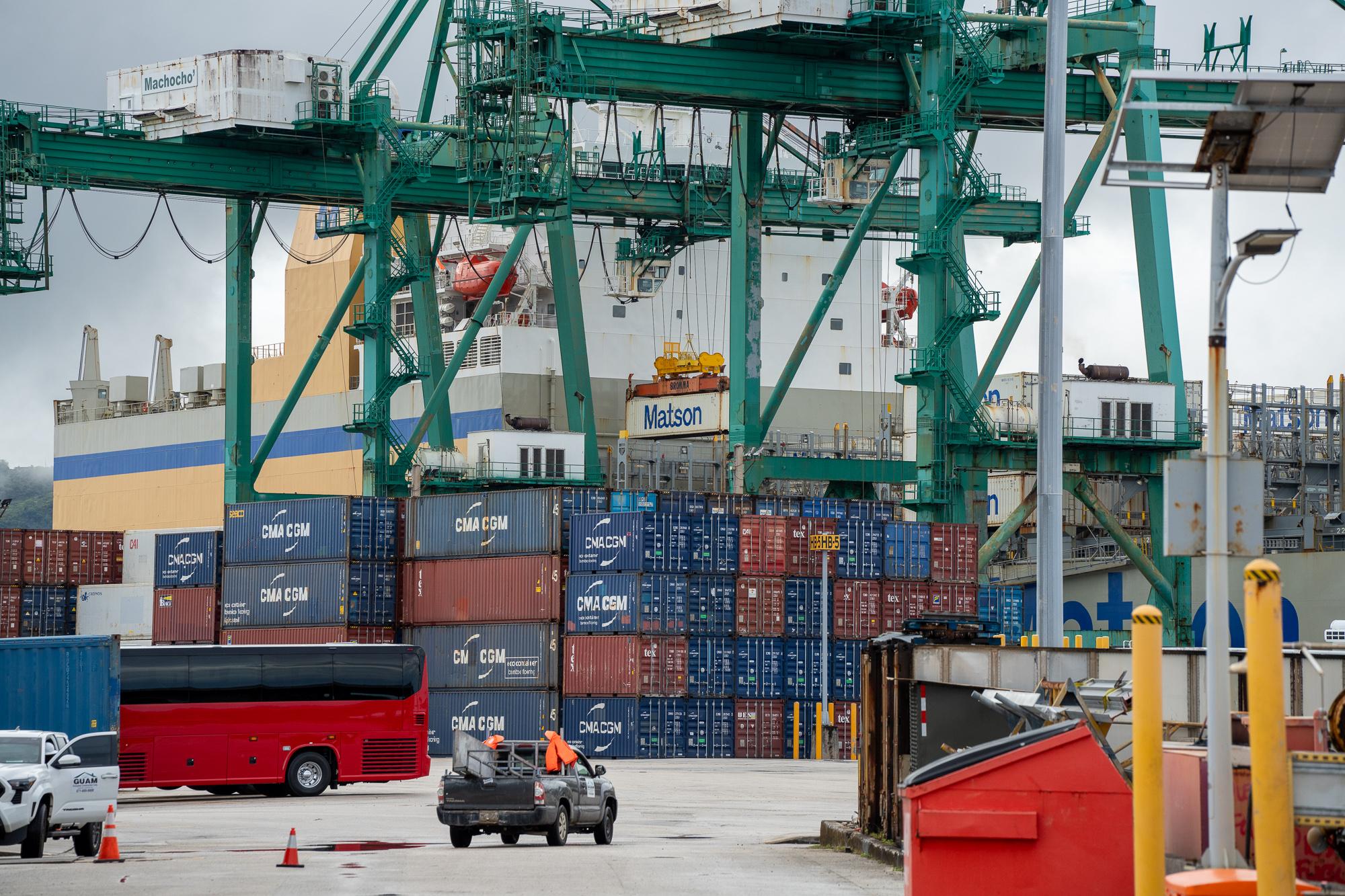
Cargo being offloaded at the Port of Guam. Photo by Skyler Obispo
“It is not impossible that the current activity of transshipping of chilled tuna at Guam could disappear as quickly as it came,” the port accurately predicted.
Ultimately what killed the tuna industry was the fish leaving Guam.
In the 2024 Report on Transshipment Feasibility and Economic Diversification by Matsuda & Associates LLC for the Guam Transshipment Task Force, data collected by the firm found that the export of fish had been strong until 2021, until it was interrupted by a southward shift of the tuna population in the waters surrounding Guam.
Southeast of Guam is the Marshall Islands which the Journal reported previously had rapidly grown its tuna industry since at least 2022. See marshalls-walmart-tuna-supply-deal-doubles-tonnage In addition, Guam, the Northern Mariana Islands and American Samoa were allowed to transfer their annual tuna catch limits to U.S. vessels operating out of Hawaii.
The 1990 Guam Department of Commerce report stated the Federated States of Micronesia and Palau are closer to prime tuna fishing grounds.
“This proximity allows longliners to deliver a fresher product and obtain higher price for better quality,” the report’s authors wrote.“This is more than enough economic incentive for longline fleets to be interested in home porting closer to the fishing grounds.”
This decline in population is backed up by research presented at the Western Pacific Regional Fishery Management Council’s 159th Scientific and Statistical Committee Meeting in Honolulu on March 17.
The Guam Coastal Fisheries Management Plan 2025 prepared by the University of Guam Center for Island Sustainability and Sea Grant, shared at the meeting, reported an approximately 60% decline in reef populations primarily due to overfishing, but also erosion, tourism industry growth, climate change, nutrient pollution, and increased availability of advanced fishing technologies.
The Journal spoke to the Port’s General Manager Rory J. Respicio at the inaugural Pacific Agenda: Investment, Security, and Shared Prosperity Summit in Honolulu on Feb. 24. He said there were opportunities and discussions to revive that industry.
But the focus of the future of Guam transshipment might be moving towards other industries as well. Angelene Rios, special projects coordinator at the Guam Economic Development Authority, confirmed to the Journal, “ … we are communicating with an investor from SelectUSA. Talks are ongoing with this investor regarding potential growth of the aquaculture industry on Guam.”
Matsuda and Associates surveyed several of what they described as “key stakeholders” which included CEOs, government directors and administrators, and C-suite executives among others, totaling up to 14 respondents.
According to the survey data, 10 of those surveyed believed the transshipment of aquaculture products has the most potential with other industries like pharmaceutical products, additive manufacturing of spare parts, and specialty textiles also being viewed as having potential.
Aquaculture on Guam primarily services the local market, but Matsuda and Associates said the expansion of aquaculture could be beneficial, if supported. mbj
Guam Business Magazine appreciates the fact that Sen. William A. Parkinson reads the magazine, as do other senators, and no doubt he reads the Marianas Business Journal also.
One week after Super Typhoon Bavi, Guam’s public utility infrastructure has approached near-total recovery, with the island-wide power system restoring 96% of customer demand and the water utility bringing 95 wells back online.
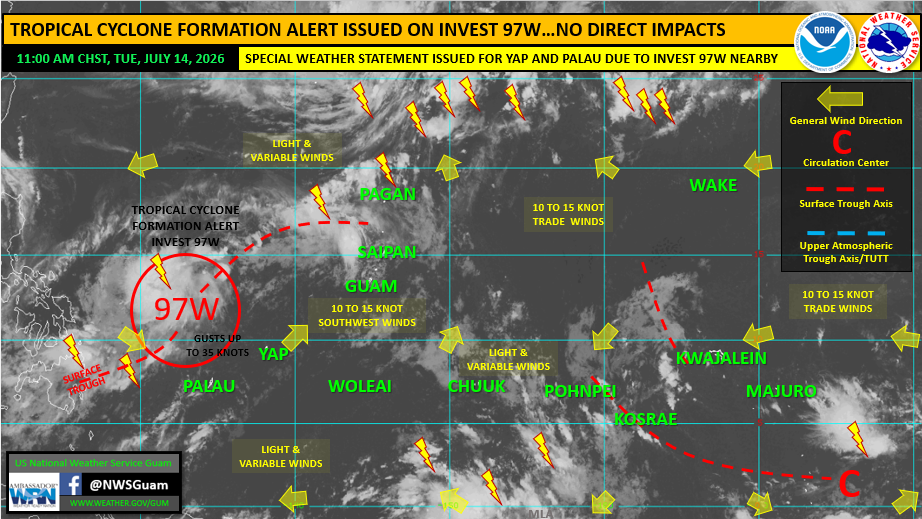
A regional tropical cyclone formation alert has been issued as a developing weather disturbance northwest of Yap threatens to strengthen the seasonal monsoon across western Micronesia and the Mariana Islands.
Contributing to Valiant Shield 2026, the Guam National Guard joined the Washington National Guard in Palau to demonstrate expeditionary sustainment exercises providing logistics, medical, and communication support.