Hammer away: village construction and renovation quietly builds
BY MAUREEN N. MARATITA
Journal Staff
It’s not hard to find a major construction project in the Journal or its archives.
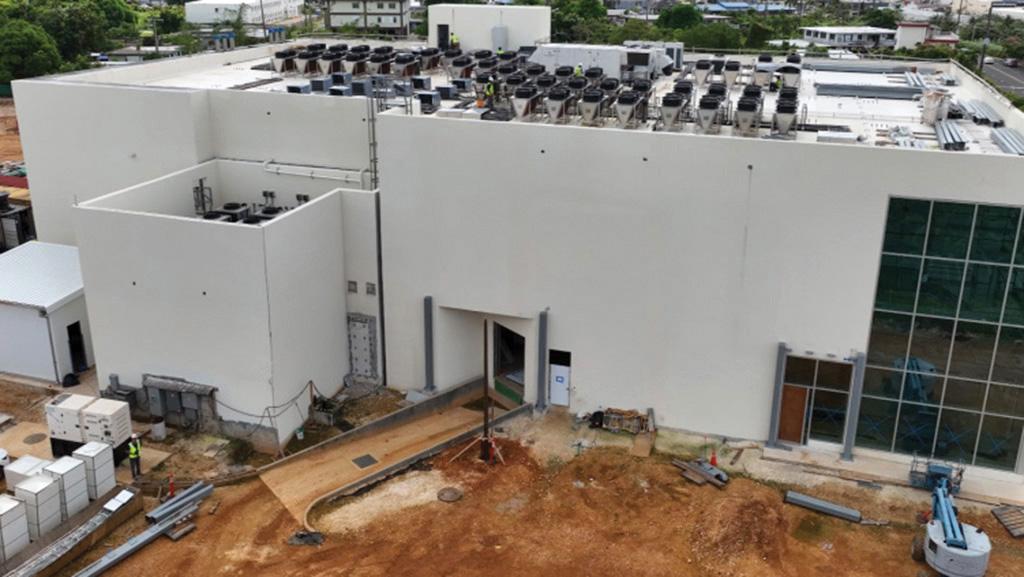
For example, there is GTA’s newest Tier 3 data center and cable landing station, road works, and the new Cost-U-Less building in Hagåtña — which took a leap forward into the public eye with the installation of signage and more.
GTA’s newest Tier 3 data center and cable landing station is poised to open in Tamuning. Photo courtesy of GTA
And military construction continues on the island’s military bases — if slower than the Department of War or Naval Facilities Engineering and Systems would like.
The installation of solar panels on both commercial and residential properties by Pacific Solar & Voltaics, Generation Renewable Inc. and other companies continues unabated.
Medium sized projects include renovations at St. John’s School and a number of Government of Guam properties, as well as the Guam National Guard’s property at Fort Juan Muna.
Commercial projects for residential housing have included the construction of seven town homes in Yigo by Mega United Corp. Several barracks for H-2B workers have or are being constructed.
Some developments aim to take advantage of the shortage of housing for both sales and rent. Additionally, multi-unit property owners are improving their properties as the market for rental units has also become competitive, and a limited number of new commercial units are appearing, despite the glut of commercial units for rent in Guam.
But in quiet streets in the island’s villages, other construction is also humming.
In the first four months of fiscal 2026 — from Oct. 1 to Jan. 31 — 65 homeowners either sought permitting to build houses or to make improvements to their properties.
According to Guam Department of Public Works records, permits varied for various stages of construction from clearing of property to replacement of electrical systems, to full construction of single-family homes — and one container home — or renovation projects with notable features or improvements.
Of the 65, 11 homeowners are self-building dwellings.
Mostly, property owners are building single family dwellings — varying in size from two to four bedrooms. Many of these include garages or carports, and several have gated fences.
Other homeowners are building a second story to expand the original footprint of the house on their property.
Some owners are fulfilling apparent wish lists with decking, a lanai, an exercise room, a generator room, an extra bathroom and walk-in closet, an outside kitchen and bathroom, and a pool with spa added to their properties. Additional storage space is popular. One owner had the property backfilled to bring it to the level of the street.
In the past year, three houses were converted from a tin-roofed dwelling to a concrete roofed one.
Expansion of an existing property is more economical as construction costs increase, rather than moving to a larger house or one with more exterior land and facilities.
Could Guam be seeing the rise of the middle-class, as the desire for more amenities and features results in home improvements?
Whether that’s the case or not, Siska S. Hutapea, president of Cornerstone Valuation Guam Inc., said the development is a positive financial move, as homeowners “build equity.”
HutapeaWhile there is a limited number of property owners who are carrying out their own construction, it is predominantly the smaller construction companies — of which there are a notable number — that are experiencing their own positive economic curve upward as owners look to them to complete building and renovation work.
The Joint Center for Housing Studies at Harvard University reported in March 2025 that “the U.S. remodeling market soared above $600 billion in the wake of the pandemic and, despite recent softening, remains 50% above pre-pandemic levels.”
Despite that, the Harvard report said, “However, industry fragmentation, inflation, and a shortage of skilled trade labor jeopardize the ability of the industry to fully meet demand.”
Of note, Harvard said, is “The growing frequency and intensity of hazard events like hurricanes, wildfires, and flooding increased spending for disaster repairs to $49 billion in 2022–2023, an astonishing leap from $16 billion in 2002–2003.
“Additionally, the average homeowner insurance premium jumped 17% between 2021 and 2023. In 2023, homeowners also spent $139 billion on improvements impacting home energy use, nearly four times the amount in 2003.”
Harvard further said that the age of housing stock in the U.S. necessitated repairs, and that older homeowners are among groups that seek to improve their residences. The report concluded that “residential remodeling is expected to remain a formidable economic sector in the years ahead.”
By this year the trend has softened in the mainland. “Annual spending on improvements and maintenance to owner-occupied homes is expected to gradually slow through 2026,” Harvard’s Housing Studies Center said. Still, “Even with some deceleration later in the year, overall annual homeowner spending on improvements is expected to reach $522 billion by the end of 2026,” Harvard said.
Guam’s permitting figures currently mirror owner desires for improvement to their living circumstances to those in the U.S. mainland. mbj
Guam Business Magazine appreciates the fact that Sen. William A. Parkinson reads the magazine, as do other senators, and no doubt he reads the Marianas Business Journal also.
One week after Super Typhoon Bavi, Guam’s public utility infrastructure has approached near-total recovery, with the island-wide power system restoring 96% of customer demand and the water utility bringing 95 wells back online.
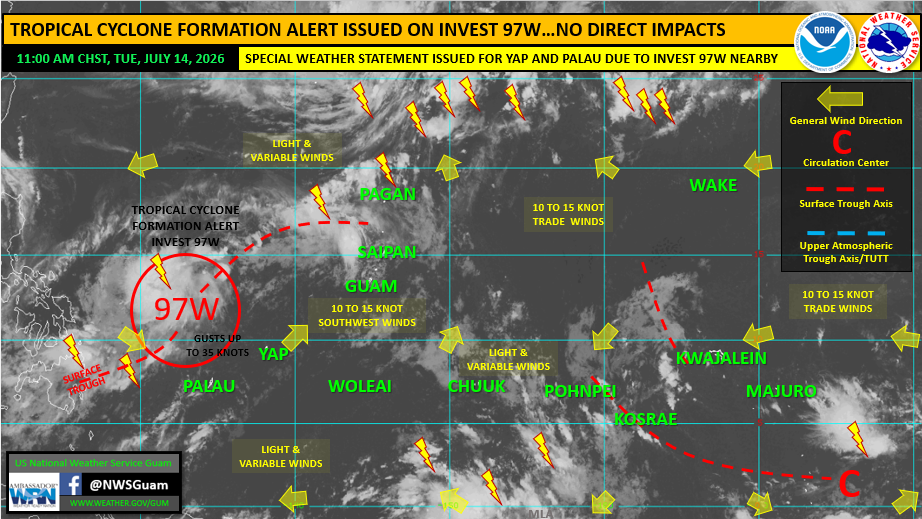
A regional tropical cyclone formation alert has been issued as a developing weather disturbance northwest of Yap threatens to strengthen the seasonal monsoon across western Micronesia and the Mariana Islands.
Contributing to Valiant Shield 2026, the Guam National Guard joined the Washington National Guard in Palau to demonstrate expeditionary sustainment exercises providing logistics, medical, and communication support.