Gubernatorial candidates share plans to revive CNMI economy
BY MARK RABAGO
Saipan Correspondent
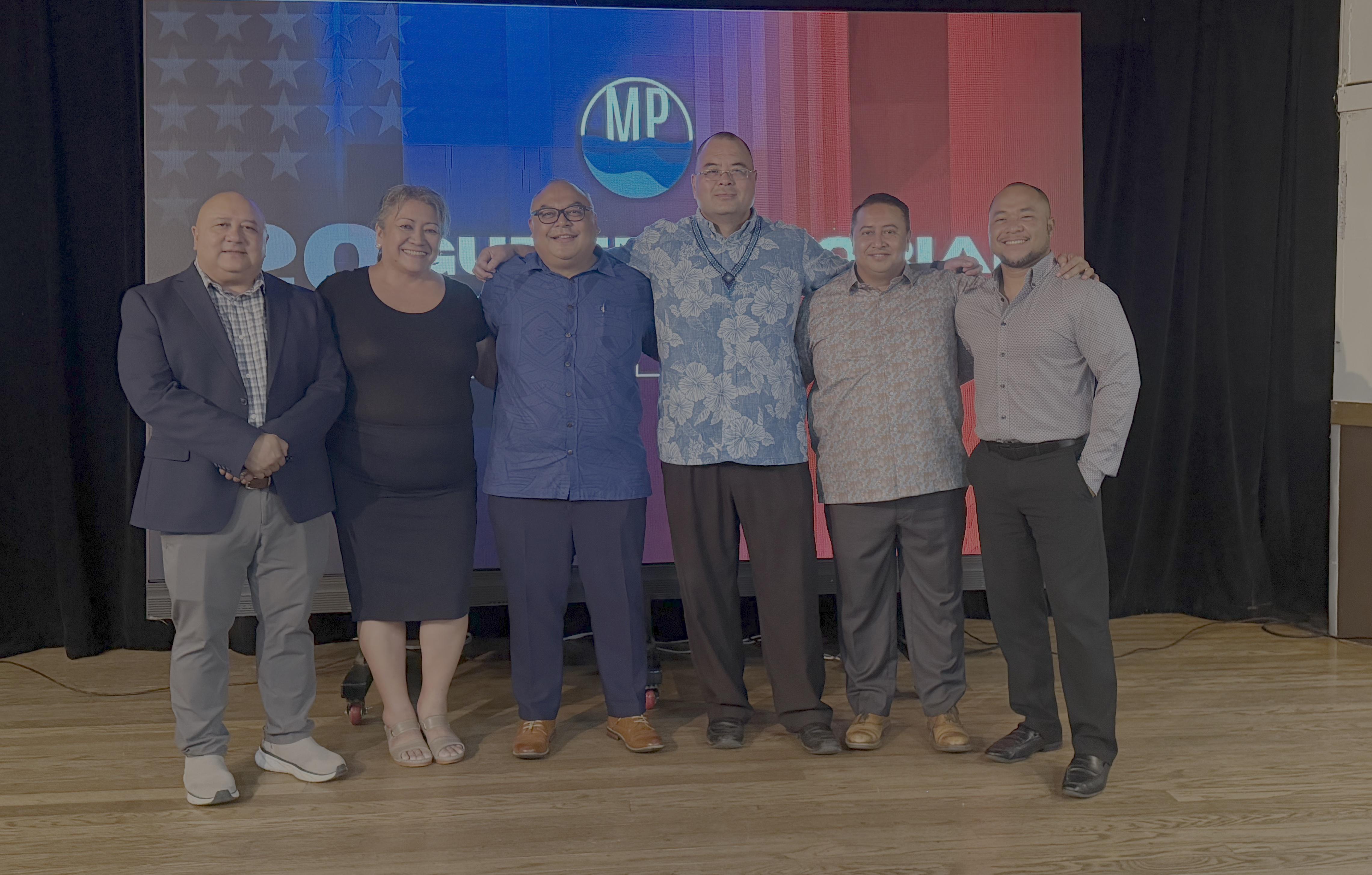
(From left) Lawrence F. Camacho, Edith Deleon Guerrero, Blas Jonathan “BJ” T. Attao, Edmund S. Villagomez, all independents; Ralph DLG Torres, Republican Party gubernatorial candidate and Benjamin Jones Jr., his running mate. Photo by Mark Rabago
SAN ANTONIO, Saipan — With the Northern Mariana Islands facing a shrinking private sector, workforce shortages, declining government revenues, and the prospect of hundreds of public-sector furloughs, the three candidates for governor are offering competing plans to rebuild an economy still struggling to regain its footing.
Lawrence F. Camacho, Blas Jonathan T. Attao, and Ralph DLG Torres put private-sector growth at the center of their economic pitches during the Marianas Press 2026 gubernatorial debate Aug. 18 at Pacific Islands Club Saipan, but differed over government spending, workforce development, investment, the military buildup, and what lessons the NMI should take from the collapse of Imperial Pacific International (CNMI) LLC and its Saipan casino.
Camacho, an independent and former education commissioner; Attao, an independent and longtime House representative; and Torres, the NMI Republican Party candidate and former governor, all agreed the private sector must grow if the islands are to reverse their economic slide.
Their differences became clearer when they were asked what budget they would send to the Legislature today and what they would cut or protect.
Camacho pointed to two scenarios presented to lawmakers that could involve 200 to 400 furloughs or reduced work hours. He said education, public safety, and health should remain priorities while government examines its finances and “right-sizes” operations. He also said government employees need viable employment alternatives in the private sector.
Attao said spending reductions should start with the governor and lieutenant governor. “We will make cuts, first and foremost, from ourselves,” Attao said. “We want to start from us.”
Attao proposed using Northern Marianas College and Northern Marianas Technical Institute to retrain government employees for private-sector positions, including accounting and HVAC jobs, provided businesses have openings and can offer wages sufficient to attract workers.
Torres said he would first protect Public School System funding and retirees before determining where reductions would fall elsewhere. “I would take PSS budget, put it aside. That's not negotiable,” Torres said. “Take that PSS money out. Put money for the retirees. Then we deal with whatever we have to deal with.”
Torres repeatedly argued that the longer-term answer is to grow the economy rather than simply manage a shrinking government budget.
That produced one of the sharper exchanges of the debate.
Attao alleged that when Torres faced declining financial resources in 2019, his administration imposed a 13% across-the-board cut that included PSS and the Department of Public Safety. Torres challenged Attao to produce the report he was citing and disputed his characterization of his record.
Camacho then took aim at both men. “I love the fact that you guys are jabbing at each other back and forth, but I'm going to respectfully jab at both of you,” Camacho said. “The question is, what the heck happened? Why are we in this situation?”
Camacho also pointed to the Building Optimism, Opportunities, and Stability Together, or BOOST, program and questioned why the influx of federal money had not produced more lasting benefits for small businesses.
He said, “BOOST money, right? Why isn't that now trying to make our small businesses thrive?” BOOST used federal American Rescue Plan Act funds to provide assistance to businesses and nonprofit organizations and was implemented during the Torres administration.
Attao took another apparent swipe at government spending during his closing remarks, although he did not name Torres. “We shouldn't squander what previous generations have built for us on fraud, a boost, or Cheetos that cheat the people,” Attao said.
Torres, meanwhile, defended his record in office when the debate turned to government accountability.“No governor has been more scrutinized than myself,” Torres said, noting that the FBI had searched his office and home and asserting that the federal investigation resulted in no FBI charges against him.
He returned to the subject in his closing statement, saying, “I am the most scrutinized governor in CNMI history.” Torres said his office, bank account, and home had been searched and again asserted that the FBI brought no charges after a six-year investigation.
The candidates were asked about the final order in IPI’s bankruptcy, which the debate question said lists about $40.9 million in combined claims for the NMI treasury and Commonwealth Casino Commission, with no guarantee the government will recover the full amount. They were also asked how they would prevent another major investor from leaving the NMI with millions in unpaid government claims.
Attao called for stronger vetting of future large investors while putting more emphasis on smaller businesses. “Little footprint, maximum economic activity,” he said.
Torres said government should be prepared to work with major investors when economic conditions change but should still require them to meet their obligations. “But yes, at the end of the day, we want them to pay their dues,” Torres said.
Camacho said he would seek a meeting with IPI’s new owner to determine what it intends to do with the unfinished casino property. He said the broader lesson from the casino experience was that the Commonwealth should avoid relying on what he called “artificial economic growth” and instead recruit sustainable specialized industries.
Asked how they would strengthen local schools, NMC, and skilled-trades programs while ensuring training translates into jobs paying livable wages, Camacho advocated aligning PSS, NMC, NMTech, the Department of Labor, and employers around the skills businesses actually need.
“After 2030, we're going to be in trouble here because we don't have the workforce that we're going to need if we're going to be building the economy back up on its feet,” Camacho said.
Attao advocated partnerships between businesses and NMC, including scholarships tied to employment commitments after graduation. He said such arrangements could help keep workers and money in the islands.
Torres proposed directing more scholarship resources toward NMC and continuing investment in NMC and NMTech, but said workforce programs would accomplish little without an economy capable of employing graduates. “None of these matters if we don't have an economy,” Torres said.
Asked where they stood on the military buildup, Attao said military contractors should register locally and pay NMI taxes and argued that federal defense activity should produce tangible benefits for health care, ports, and other infrastructure. “We're not going to beg for it. We're not going to ask for it. We're going to demand equal opportunity for our people here in the CNMI,” Attao said.
Torres said the federal government should invest in communities affected by military activity. “They need to own up on making sure they're part of the community,” he said. “I will demand for them to make investments.”
Camacho, a retired military officer, similarly argued that the NMI should use its strategic importance to negotiate for infrastructure and economic benefits rather than simply accept federal decisions. “Gone are going to be the days where we just sit around and we accept what they tell us,” Camacho said. “The days are coming when we tell them what we need from them and we're going to demand it.”
The economic focus mirrored the Saipan Chamber of Commerce’s 2026 CNMI Lt. Governor Candidates Business Forum held Aug. 5 at the Kensington Hotel, where the three lieutenant governor candidates likewise put the economy and workforce at the center of their pitches to the business community.
House Speaker Edmund S. Villagomez, Attao’s running mate, called for assessing and cross-training government workers while pursuing industries that generate secondary business activity; Republican Benjamin Jones Jr., the running mate of Torres, argued that rebuilding the private sector should come before cutting government jobs and identified pharmaceuticals, ship repair, agriculture, and fisheries as potential growth areas; and former Senate president Edith Deleon Guerrero, Camacho’s running mate, favored gradually reducing government payroll through attrition while pursuing financial services, entrepreneurship, and less labor-intensive industries.
All three lieutenant governor candidates also backed efforts to stabilize the foreign workforce and emphasized utilities and infrastructure resilience following recent typhoons. mbj
United Airlines Holdings, Inc. reported an all-time record total operating revenue of $17.9 billion for the third quarter of 2026, representing a 17.4% increase compared to the same period in 2025.
Just hours after Super Typhoon Champi passed south of Guam, President Donald Trump approved Gov. Lourdes A. Leon Guerrero's request for an emergency declaration, which authorizes the Department of Homeland Security's Federal Emergency Management Agency to coordinate emergency assistance.
SAIPAN, Northern Mariana Islands — For a growing number of Northern Mariana Islands entrepreneurs, a folding tent, a table, some inventory, and a few hours in front of a weekend crowd can be the first step toward something much bigger.