SAN ROQUE, Saipan — Northern Mariana Islands government and business leaders outlined strategies to revive tourism, expand economic sectors, strengthen workforce development, invest in infrastructure, and leverage U.S. military spending during the Saipan Chamber of Commerce Economic Forum on March 11 at the Kensington Hotel Saipan.
Kimberlyn King-Hinds, the NMI’s delegate to Congress, announced that 34 members of the U.S. House of Representatives had sent a letter to the Department of Homeland Security calling for a review of the Electronic Visa System for Travel Authorization Program.
“You will soon hear in the news … that 34 House members this morning issued a letter to Homeland Security asking for a review of the EVS-TAP program,” King-Hinds said. “There’s some concerns because of the geopolitics and the ongoing conversation with regards to birth tourism.”
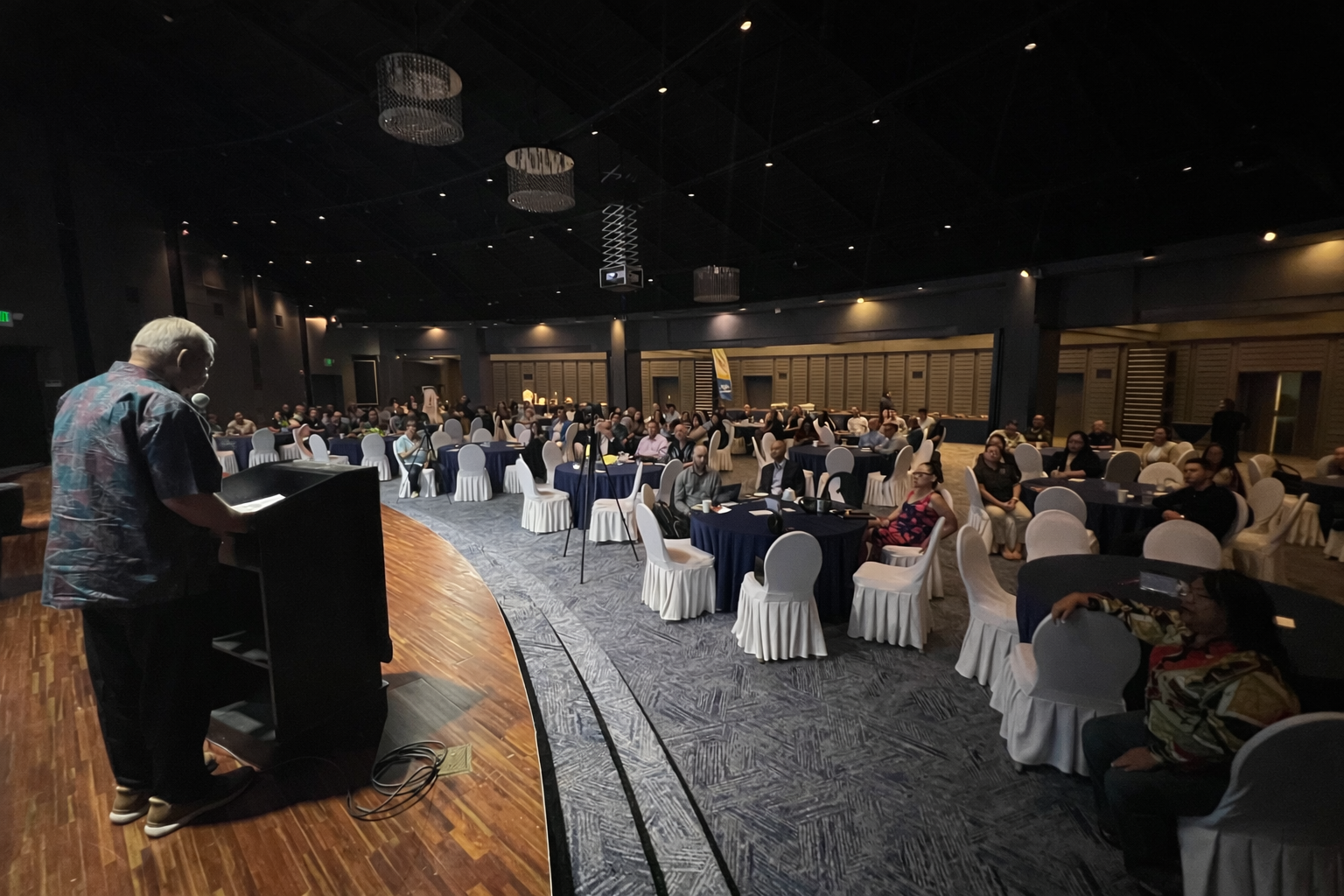
Apatang speaks to attendees at the Saipan Chamber of Commerce Economic Forum. Photo by Mark Rabago
She emphasized the importance of consistent messaging from NMI officials and business leaders about tourism’s economic role.
“What is clear to me … is that a lot of this conversation is not based on facts,” she said. “Whenever somebody says the word China market … I don’t care where the tourists come from. What I care about is customers. Because every business needs customers to survive.”
Gov. David M. Apatang highlighted ongoing efforts in Washington, D.C. to push for policy reforms, including faster EVS-TAP processing and expansion of the Guam-CNMI Visa Waiver program.
“These could be easier fixes that lead to action in Congress,” Apatang said. “It wouldn’t cost the federal government any money.”
Jamika Taijeron, managing director of the Marianas Visitors Authority, set a target to restore annual visitor arrivals to 500,000 within five years. “This may seem optimistic…but we have been there before and we can do it again,” she said.
Air access remains a critical factor, with Commonwealth Ports Authority Chairman Bartley A. Jackson noting that Philippine Airlines’ Manila-Saipan service is on track to launch March 29.
“There’s no lack of interest, there’s no question, there’s no nervousness on behalf of PAL about their flight to the CNMI,” Jackson said.
Panelists emphasized reducing the NMI’s dependence on a single industry to strengthen economic resilience.
Jay R. Merrill, president and CEO of Market Research & Development, noted the territory’s vulnerability. “The economy as a whole is at one of the lowest points it's been in well over 20 years,” e hsaid. “Tourism is down by 66%.”
Sports tourism is emerging as a potential growth driver. John Hirsh of the Northern Marianas Sports Association said regional competitions generate significant visitor spending.
“These are folks that are not only participating in sports, being excited, having fun, but they're spending money, they're staying in the hotels, they're eating in the restaurants,” he said.
Healthcare also contributes significantly to local employment and economic activity. Esther L. Muna, CEO of the Commonwealth Healthcare Corp., said, “Of the 47,000 residents of the CNMI, we have 1,000 employees that are spread throughout Saipan, Tinian, and Rota. It is basically one of the largest single employers in the CNMI.” Local service expansion has reduced off-island medical referrals: “We were spending $18 million. It went down to $9 million,” Muna said.
Labor shortages remain a pressing concern. Labor Secretary Leila F. Staffler urged businesses to hire and train local workers. “When I look at a business that's bringing in a foreign worker to wash dishes, I think that that's a travesty,” she said. “We have 600 people looking for jobs, and I bet one of them could wash dishes.”
Galvin Deleon Guerrero, president of the Northern Marianas College, said shortages go beyond training. “What has been pitched as a workforce development problem is really simply a workforce problem,” he said. “Even if employers hired everybody, it would still not be enough.” Panelists also highlighted education reforms and career academies as part of long-term solutions.
Aging utilities, airports, and digital networks were highlighted as constraints for economic development. CUC Chief Financial O Betty Terlaje, chief financial officer of the Commonwealth Utilities Corp., said most of Saipan’s generators are years old. “Except for the newly commissioned diesel engine … the remaining 19 engines that we have located at Power Plant 1, 2 and 4 are very old, spanning from 26 to 40 years in age,” Terlaje said.
Esther Ada, executive director of the Commonwealth Ports Authority, stressed the terminal at Francisco C. Ada/Saipan International Airport needs eventual replacement. “Saipan International Airport has served the CNMI for nearly 50 years and is beginning to show its age,” Ada said.
Officials also noted road projects, solid waste improvements, and an $81-million federal broadband grant to expand fiber infrastructure across the islands.
The U.S. military buildup in the Mariana Islands presents potential business opportunities.
Tinian Mayor Edwin P. Aldan said, “The military field of Tinian represents one of the most significant federal investments in the history of our island. However … an important question remains not only on how much is being spent, but how much of that spending is circulating within our local economy.”
Edward Camacho, director of the CNMI Bureau of Military Affairs, added, “The messaging is no longer, if it’s good for the military it’s good for the Commonwealth. It’s not that. If it’s good for the Commonwealth, it’s going to be good for the military.”
Rear Adm. Brett Meitus, commander of Joint Region Marianas, said military investments will include construction and long-term operational spending. “Everybody gets really focused on the build part, but it’s not just build. We talk about build, sustain and then operate from … When forces come in, those forces stay in hotels, they have their meals, they spend money in the local economy.”
Opportunities for local contractors were highlighted by Glenna S. Palacios of Marianas Integration LLC, who recently secured a Navy contracting position covering Guam, the NMI, and American Samoa. “We have seen so many companies outside of the CNMI coming in, capturing all these contracts that are coming to the CNMI,” Palacios said. “We can do it. We just need to be able to get together.” mbj
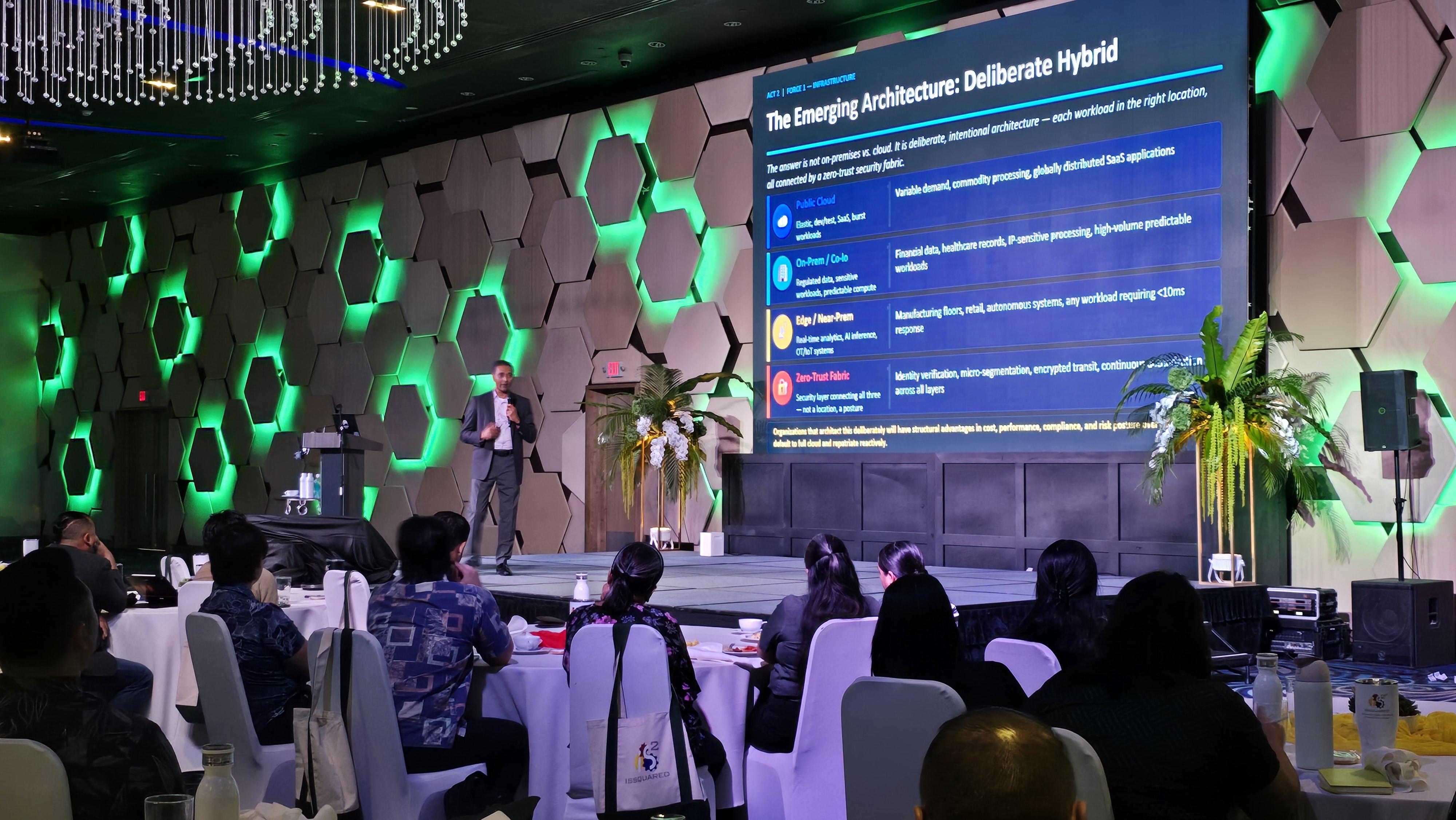
Rapid advancements in artificial intelligence, escalating cybersecurity threats, and mounting physical power grid constraints are forcing regional business leaders to fundamentally overhaul their technology strategies, shared to industry experts during a technology conference held on July 23 at the Dusit Thani Guam Resort.
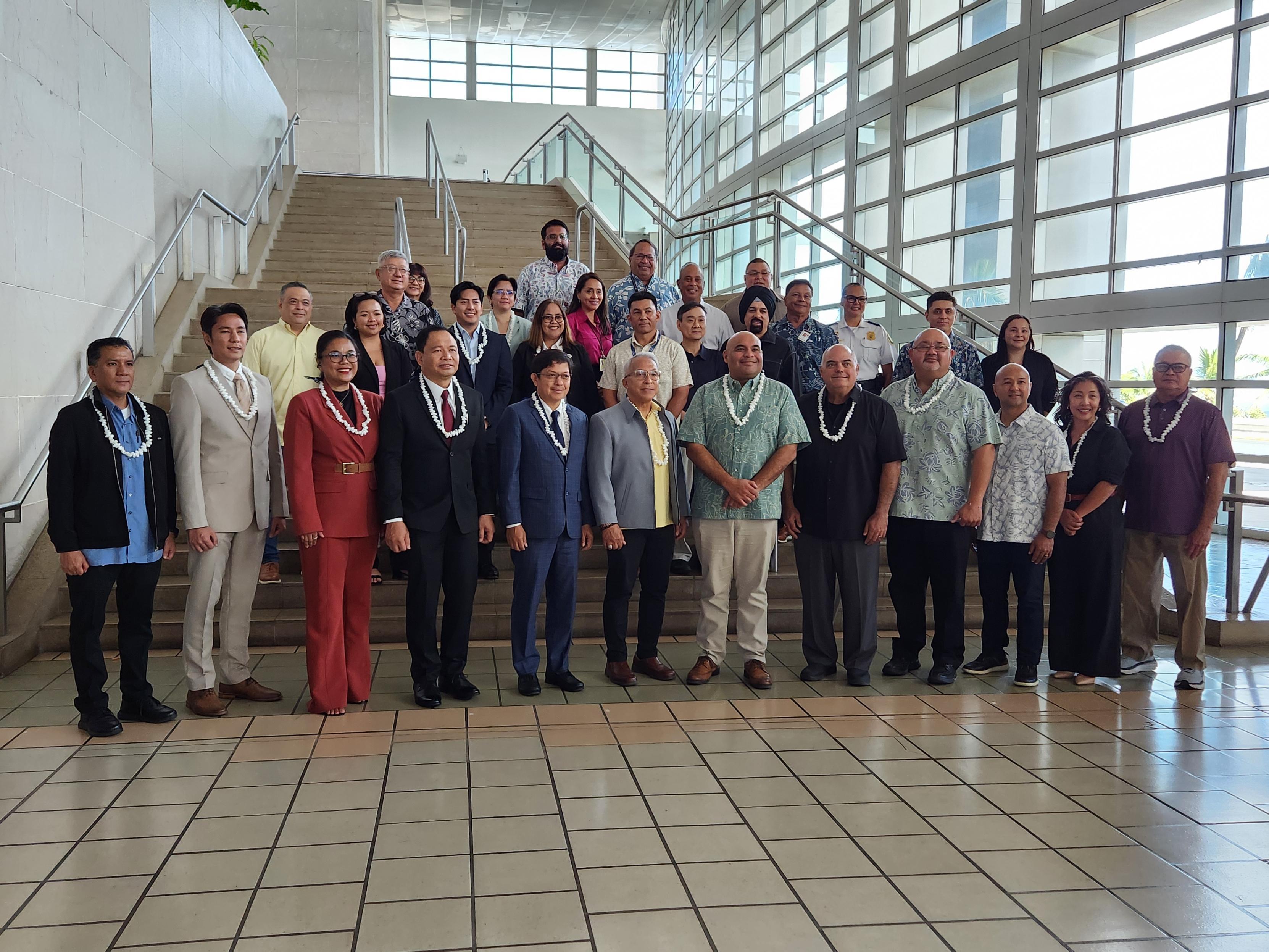
Regional leaders, government officials, and industry executives gathered at the Guam International Airport Authority on Wednesday, July 22 for the inaugural session of the Guam-CNMI Visa Waiver Working Group, driving a unified regional effort to expand the Guam-CNMI Visa Waiver Program to include the Philippines.
The commercial adult-use cannabis industry on Guam has officially launched following the issuance of the island's first recreational cannabis cultivation license to local grower Stephen Roberto, operator for Deep Green Guam of Guam Real Deal, LLC.