There can be no worse situation than the need to medically evacuate a seriously ill family member from the islands in a hurry.
For those who can or must utilize an urgent air ambulance flight there are options.
Optimum Air is a medical transport service that is headquartered in Las Vegas, Nev., where it was founded, according to Jon Rosati, chief strategy officer.
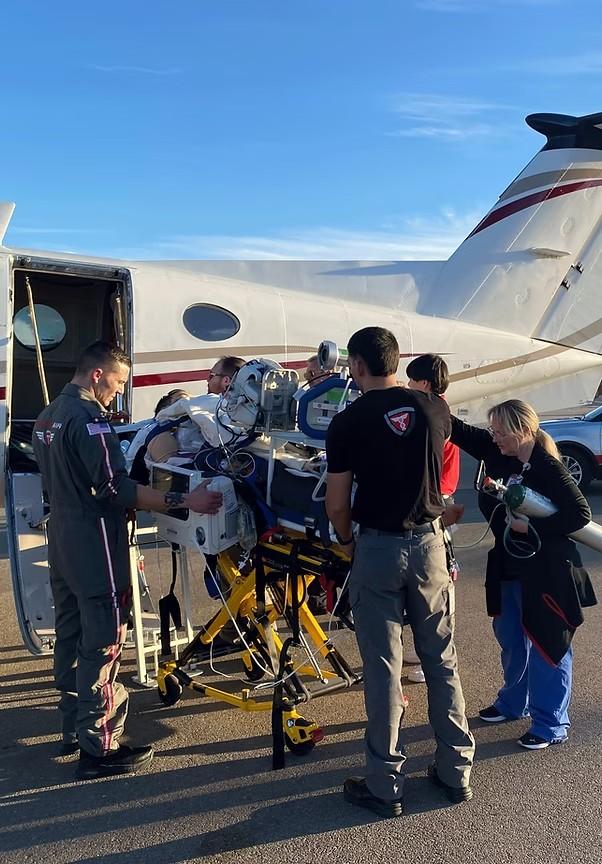
Optimum Air has a variety of plans to meet air ambulance transport needs. Photos courtesy of Optimum Air
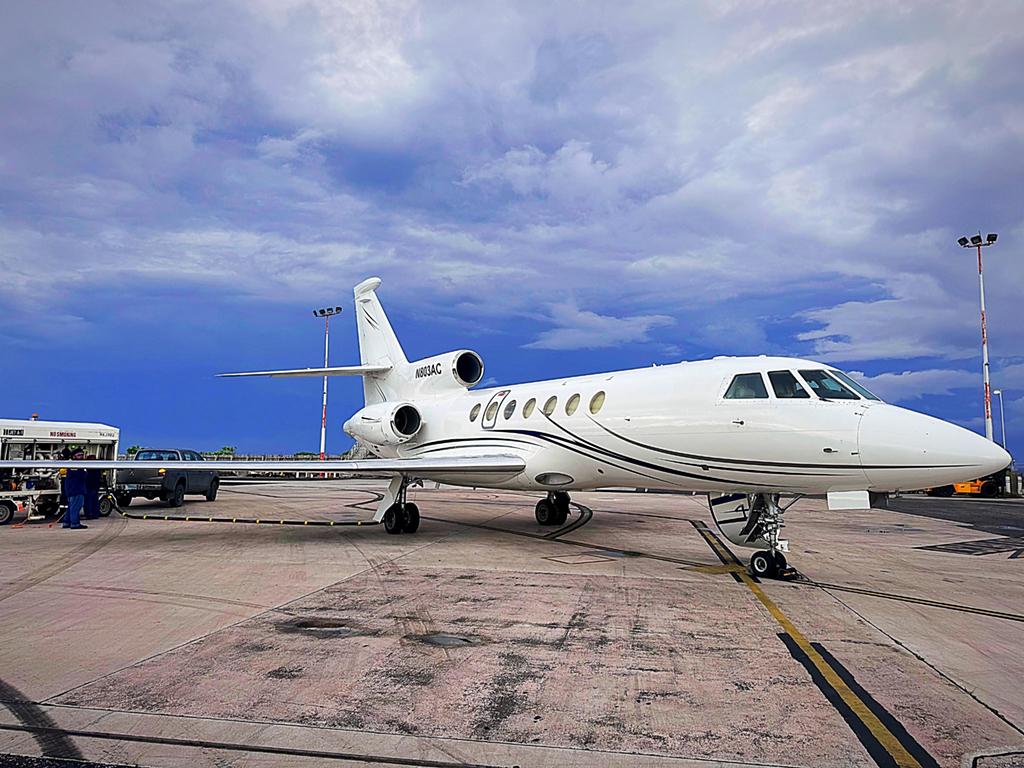
“And then we have our Honolulu, Hawaii operation, which is like a satellite base. That is where our long-range international program is based,” he said. In Hawaii, Optimum has one Dassault Falcon 50, which is a three-engine jet used for long range flights, and a Pilatus PC-12 — a single engine turbo prop. That plane has a big cargo door, Rosati said. “We built a specialized loader system for both aircraft, which allows the patient to be easily lifted up and lowered from the plane.”
Technically, both locations handle international flights, Rosati said, with the U.S., Canada, Mexico and central South America serviced from Las Vegas.
Optimum has a 24/7 communications center for calls at no charge. “When you are talking to families, you are talking to highly stressed, aggravated individuals; when you are talking to hospital staff or an insurance company case manager it’s sometimes a little more controlled and calm,” Rosati said. “The environment we operate in is highly stressful. There’s so many factors and variables that you’re juggling at all times.”
RosatiOptimum has about 100 staff, with 75 of them full-time employees and about 25 on a per diem rate. “A lot of our physicians are per diem, which means we don’t pay them salary; they’re per assignment, per day usually,” Rosati said.
Many of the physicians are specialists, he said. “We have a Hawaii medical director; she’s a cardiac thoracic surgeon with a strong background in intensive care level of care.” He said many patients are on life support and that particular surgeon performs surgery to put people on certain types of ECMO, which is a temporary life-support technology that acts as an artificial heart and/or lung for patients with life-threatening, reversible heart or lung failure.
“We are one of the only air transport companies in the country that offers in-house high level of care solutions such as ECMO. We do other types as well. There’s a special machine you have to purchase; we own one.”
Optimum flies its clients to multiple locations, Rosati said. He noted the proximity of the Philippines from Guam but recognized other preferences. “A lot of our patients from Guam will go to the U.S. mainland, which can be in excess of $200,000, especially now that the fuel prices are going up... That’s taken a toll for sure.”
Some patients from American Samoa will go to New Zealand or Australia, he said. “They’ll go to those countries for treatment, rather than bringing them all the way to the U.S.” Honolulu has some great services, he said, and Optimum has flown patients there too.
Optimum is accredited by the National accreditation Alliance of Medical Transport Applications, which independently evaluates members according to national and international benchmarks. “There are three accreditation bodies in our states. We chose NAMTA because they are recognized by the Department of Defense, with whom we work quite a lot, and that’s the only accreditation body recognized by DoD,” Rosati said.
He said though it can vary, there is about one military medical evacuation a month and Optimum has the required clearances, to include for both Wake Island and Kwajalein. “Through one of our private clients we have those relationships …,” he said.
According to a U.S. Pacific Command study for the 10 years between 2008 and 2018, the vast majority of evacuations for U.S. military personnel from Japan, Korea and Guam were for medical conditions (87%), with only 13% related to injuries. Japan was the leading origin point, accounting for 36.4% (1,210) of transports, followed by Guam (27.8%). Hawaii was the most frequent destination for patients (38.4% or 1,278 transports). Evacuees are largely divided between active-duty military (48.1%) and U.S. civilians/contractors (51.3%).
Overall, Rosati said operating in the islands has been straightforward. “We’ve got really great relationships. We’ve really not had much trouble as far as operating. I personally have been coordinating and involved with air ambulance transportation in the Pacific for more than 10 years, so over those years I’ve developed a lot of relationships with almost every island in the Pacific.”
Optimum’s presence in Hawaii became attractive, he said. “As a company, Hawaii was a natural step for us, because of the relationships that I’ve had with the healthcare system there — relationships that go as high as the governor’s office — and we own the company based in Honolulu that has aircraft capable of reaching these far reaches — the mainland U.S. and the far South Pacific.” Optimum has specific equipment and personnel for patients in transit.
The longest distance an Optimum air ambulance had traveled was likely to transport a patient from Vietnam to San Jose in California, Rosati said. “We are truly worldwide. Our aircraft fly six hours to seven hours at a time without landing. There’s a lot of logistics involved in these long air transports, but we have ways of moving our crews around so that we can perform a continuous flight transfer, which can sometimes be in excess of 20 hours of patient time.”
Refueling is part of transport logistics. “It’s all coordinated through the airports that we go, so we have a representative that we work with at each airport. We have relationships with many fuel vendors and we are constantly talking with them, I would say on a weekly basis negotiating pricing.” Optimum’s business is typically highly sought, he said.
Aside from coordinating air ambulance services, Optimum provides escorts on airlines.
“We have a contract and we staff commercial medical escorts with our medical staff — our flight nurses or paramedics so we help them when they have an oxygen concentrator — all these other things.” The company also works directly with insurance companies on medical insurance, travel insurance and has corporate clients, and works with governments, both foreign and domestic, Rosati said.
He is sensitive to the impact of its business on some clients. Medical expenses and related income loss are consistently cited as the leading cause of personal bankruptcy in the U.S., accounting for roughly 40% to over 60% of filings.
“We are going to create a fund for some of the under-privileged to be able to have access to services without the risk of financial devastation when their three-year-old needs surgery that’s not covered, or something like that.” Plans are to spread the effect widely, he said. “We’d like to expand it to the greater region.”
Optimum will celebrate its 10th anniversary next year, and its founders included practitioners from the transport world, and some physicians. “The idea behind the company was to effect change in healthcare and how its delivered. Our area of healthcare happens to be transport, ground ambulance and air ambulance side.”
The air ambulance business base in America has two main players that absorbed smaller companies — both emergent and non-emergent, Rosati said. “We straddle that line between emergent and non-emergent,” he said. “We try to contract with as many payers as will contract with us for a rate that we can live with, and we try to minimize the impact of people using our services on the people using our services.”
Rosati recognized the impact of cost on middle class individuals earning modest salaries, who do not have large savings set aside for emergencies. “Taking an air ambulance ride can ruin your life. It’s our goal to not have that happen to people. We have ways that we do that.”
While Optimum is a business, Rosati said, “Our sole driving force is not profit, it’s taking care of people — and making a living along the way. I think that’s what sets us apart from any other company — the companies in the U.S. anyway.”
Insurance companies can offer help to organize an air ambulance.
Frank J. Campillo, health plan administrator for Calvo’s SelectCare, told the Journal that Calvo’s has worked to evacuate patients for many years.
Campillo“We work with several companies,” he said. For example, Calvo’s has evacuated patients to the Philippines, to Hawaii and to California, and those patients have come from Guam and other islands in Micronesia. “It’s part of the standard coverage,” he said.
“It’s not necessarily very common,” Campillo said. Typically, one or two patients a year require medical transport. “The most one year was four,” he said. Calvo’s has also facilitated medical evacuation to Korea for one patient, he said.
Uniquely, Calvo’s offers a 50% discount for its clients on the cost of medical transport, which can vary from about $65,000 to $200,000, depending on the destination. The cost of fuel would currently be a consideration.
Calvo’s has also assisted with arrangements for patients that are not its clients, Campillo said.
According to Medicare, it may pay for emergency ambulance transportation in an airplane or helicopter if you need immediate and rapid transport that ground transportation can’t provide.
“Medicare Part B covers air transport if your health condition requires immediate transport that ground travel cannot provide, such as when a location is inaccessible by ground or distance/obstacles prevent timely care,” it said.
Generally, you pay 20% of the Medicare-approved amount, which can still result in high out-of-pocket costs (sometimes thousands of dollars), Medicare said. It also said that Non-Emergency Transport is occasionally covered if a doctor certifies that medical necessity requires air travel for specific conditions.
Campillo said of air transport through Medicare, “It’s not the easiest and simplest way. It’s a little bit of a convoluted process.” He said that in some circumstances, Medicare would indeed pay for transport. However, Campillo said, “Medicare is not going to do the logistics for you.”
Arvin C. Lojo, health plan administrator for TakeCare Insurance Co. Inc., told the Journal that TakeCare plans have coverage for medical evacuation.
LojoHe said these include “hospital to hospital transfer and cover for air ambulance up to a certain limit.”
Typically, patients are sent to the closest destination, Lojo said. “Normally we fly them to the Philippines,” he said. “Before we do hospital to hospital transfer, we wait for clearance from the physician.”
TakeCare has the following guidelines for patients:
Air ambulance for qualified emergencies to the nearest off island facilities in the Philippines and/or Taiwan at 50% up to $20,000 per benefit year.
$500 travel benefit for approved referrals to the Philippines, Taiwan and/or South Korea for specialty care visits, diagnostic testing & imaging, outpatient surgery, rehabilitation therapies, in patient procedures, outpatient chemotherapy & radiotherapy when these services are not available in Guam or CNMI. The benefit may be applied towards airline tickets and/or payment for lodging and eligible members needs to complete their treatment plan to be eligible for this benefit.
Airfare benefit for hospital-to-hospital transfer to Preferred Participating Providers in the Philippines if the eligible member meets coverage criteria.
As to the number of patients sent for treatment by air ambulance, Lojo described the number as “only a handful in very limited circumstances and for certain conditions.”
TakeCare does have a relationship with a company with a presence in Asia that can assist patients. “We actually work with a company based in the Philippines and Singapore,” he said.
For families for whom the cost is prohibitive or who are in remote islands in Micronesia, Pacific Mission Aviation is a lifeline.
The non-profit, which is headquartered in Guam, has four planes in Palau — three Cessna planes and one Britten-Norman, which is designed for short take-off and landing in rugged, remote environments.
In Yap, PMA has two King Airs.
Ma. Melinda R. Espinosa, chief financial officer and administrator for PMA, told the Journal, “The King Air has twin engines so we can fly the distance and carry more fuel.”
PMA was incorporated in 1975 in Guam and in 1982 in the Philippines. The airline does offer charter flights for tourists, and while it does not charge patients it does hope for donations, particularly for fuel.
“Even our pilots don’t get paid,” Espinosa said.
In-kind sponsors have included Matson Navigation Co. And Triple B Forwarders, she said. PMA also supports disaster response and one of its planes was the first of any NGO to arrive in Saipan after Super Typhoon Sinlaku.
As of late 2025, new legislation (the Caring for Veterans and Strengthening National Security Act) was passed to improve health care access and benefits for COFA veterans, which includes support for medical transport in some cases.
The U.S. government does not provide emergency medical evacuation for non-U.S. citizens. But in Micronesia the U.S. Coast Guard periodically conducts critical medical evacuations and did evacuate a nine-year old boy from Satawal who suffered a serious head injury. He was transported on the U.S. Coast Guard Cutter Oliver Henry in April, together with his parents. The three were transferred ashore at Woleai to board a Yap State government-chartered flight for medical care in Yap. The Oliver Henry is homeported in Guam.
In January a U.S. Navy HSC-25 helicopter evacuated a 60-year-old crew member with heart attack symptoms from a cable laying vessel near Guam.
United Airlines does offer a service for passengers.
“United Airlines facilitates medical transportation, including stretcher accommodations for critical patients and the provision of medical oxygen on scheduled flights,” it told the Journal. Certain conditions apply, according to its website. “Please note that a doctor’s certificate or medical form may need to be completed and submitted in advance of departure. Customers requiring medical assistance or accommodations while traveling should contact the Guam Medical Desk at +1 671-645-8215 or CMICRC@united.com,” the airline said.
For more information, visit united.com
Traveling with Medical Conditions | United Airlines
Traveling with Oxygen | United Airlines
According to IBISWorld, in the U.S. mainland as of Jan. 1, there were 809 businesses specializing in medical transportation. There are more than 1,500 jets and helicopters dedicated to air medical services in the U.S.
These businesses focus on:
Emergency Scene Response: Transporting patients from accident scenes, often in rural or hard-to-reach locations.
Inter-facility Transfers: Moving critical patients between hospitals for specialized care.
Organ Transport: Rapid delivery for transplant procedures.
The industry is highly active, with more than 1,000 medical flights per day. In Hawaii the industry has grown from one provider to several and Life Flight — a not-for-profit medical transport program opened in Hawaii this year, with bases on several islands. mbj
What governments in the islands of Micronesia do for medically challenged citizens
Government of Guam
Darlean S.N. Salas is the director of the Guam Medical Referral Office. She told the Journal that her office does not pay for medical evacuation. “There are patients whose insurance pays for this,” she said. Her office does provide transport for family members who may not be able to travel to the medical facility in an ambulance when they arrive.
The Guam Medical Referral Office’s budget for fiscal 2026 and the two previous years has remained at $665,849. The office falls under the Office of the Governor but has its own appropriation from the general fund. The sum covers personnel and contractual services, as well as the cost of referrals which are for off-island medical treatment in Honolulu, Los Angeles, and Manila.
Government of the Northern Mariana Islands
The Medical Referral Program also known as the Medical Referral Services is under the Office of the Governor. By sending patients approved for Medical Referral to an established referral health care facilities they may obtain extended and/or advanced medical care, specialties and procedures attainable to enhance the patients’ health.
The program is the only NMI Government Office operating with satellite offices outside the NMI in Guam and Hawaii with contracted medical facilities in the continental U.S. and elsewhere.
Government of Palau
Pacific Mission Aviation provides air transport for medical evacuations, particularly for the states of Angaur and Peleliu. The country has established a national Emergency Medical Team (KLEMAT) to manage emergencies, with services often supporting residents for urgent care.
Government of the Federated States of Micronesia
The Federated States of Micronesia Medical Referral Offices facilitate off-island, tertiary medical care for patients whose treatments are beyond the capacity of local state hospitals. These offices manage referrals to facilities, often in the Philippines or Hawaii, for cases requiring specialized, high-level healthcare.
Government of the Marshall Islands
Medical evacuations are exceptionally expensive, and the government cannot cover every request. Emergency, unapproved, or immediate private evacuations are rarely funded by the government and may cost over $50,000, according to the U.S. Embassy in Majuro. mbj
Rapid advancements in artificial intelligence, escalating cybersecurity threats, and mounting physical power grid constraints are forcing regional business leaders to fundamentally overhaul their technology strategies, shared to industry experts during a technology conference held on July 23 at the Dusit Thani Guam Resort.
Regional leaders, government officials, and industry executives gathered at the Guam International Airport Authority on Wednesday, July 22 for the inaugural session of the Guam-CNMI Visa Waiver Working Group, driving a unified regional effort to expand the Guam-CNMI Visa Waiver Program to include the Philippines.
The commercial adult-use cannabis industry on Guam has officially launched following the issuance of the island's first recreational cannabis cultivation license to local grower Stephen Roberto, operator for Deep Green Guam of Guam Real Deal, LLC.